
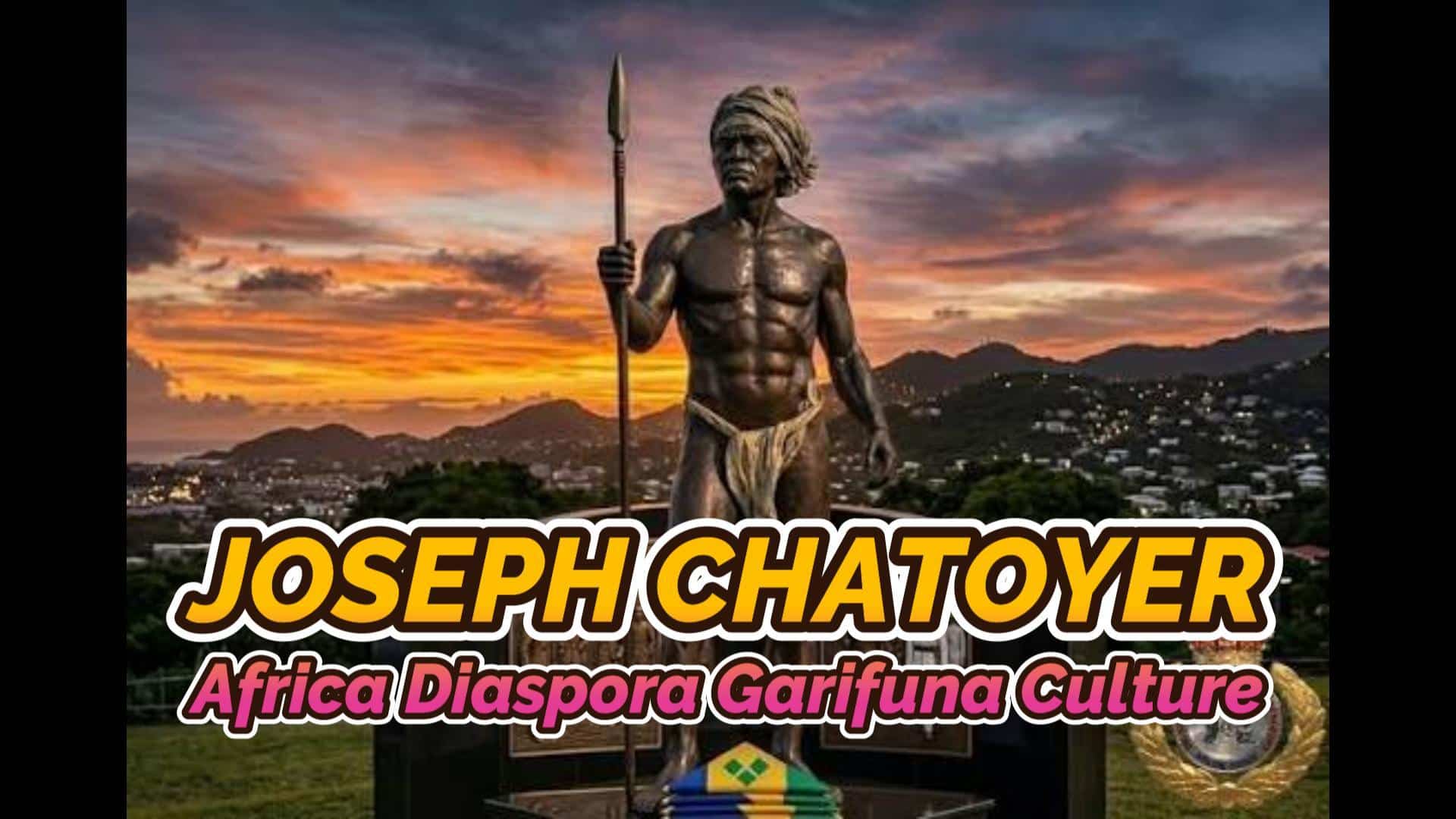

COUNTRY: Saint Vincent and the Grenadines Country in the Caribbean.
DATE OF BIRTH: Uncertain date in 1738.
DATE OF DEATH: March 14, 1795, aged 57.
CAUSE OF DEATH: He was killed by British army during what is known as the Second Carib War in Saint Vincent and the Grenadines in the Caribbean.
OCCUPATION: Paramount Chief of the Black Caribs (Garifuna), and anti-slavery revolutionary warrior in Saint Vincent and the Grenadines in the Caribbean.
Greetings from Harry Agina, the CEO of the Afro-Scope Project. I personally created the Afro-Scope “African Heroes Hall Of Fame” for the enrichment of your global knowledge of Africa. This covers African heroes on the continent of Africa, as well as heroes of African ancestry all over the world, commonly known as “Diaspora Africans.” The Garifuna community (or culture) in Central America is among the Diaspora Africa. During my Graduate Thesis project in Houston, Texas, and Belize in Central America, I christened the Garifuna community “The Most African-African Culture Outside Africa.” And, I christened the people of that culture, “The Most African-Africans Outside Africa.”
All that, to tell you that the Garifuna Culture ant its people are important to me, the Afro-Scope Project, and Africa. My co-members of our Afro-Scope family are writing the tales of African heroes of the African continent and the Diaspora Africa. I want to personally open the “Ancient Diaspora Africa” category. And, I want to open it with the tale of one of the most celebrated heroes among the Garinagu (plural of Garifuna) people. I have described them as “The Most African-Africans Outside Africa.” Naturally, the hero in question was among the most important people in Diaspora Africa in the 18th century. I speak of “The man who defied the British Empire,” as he is commonly described in Saint Vincent and the Grenadines in the Caribbean, and in Central America. I speak of one of the Africans who led African slaves in Saint Vincent and the Grenadines in the Caribbean to resist European transatlantic slavery in the 18th century. I speak of the man named Joseph Chatoyer, the late Paramount Chief of the Black Caribs.

PRELUDE: GARIFUNA CULTURE– “THE MOST AFRICAN-AFRICANS OUTSIDE AFRICA”
Once upon a day in 1635, there were a couple of shipwrecks on the Caribbean Sea. Their destination was the country of Saint Vincent and the Grenadines in the Caribbean. It was during the European transatlantic slave trade. The cargoes of the wrecked ships were African slaves from West and Central Africa and the wreck happened near the shores of Saint Vincent and the Grenadines. Most, if not all the slave traders and crews on the upper decks of the ships perished while most, if not all the African slaves on the lower decks survived. The survived slaves swam ashore and escaped into the forests. And so it was, that their struggle to resist re-enslavement by the Europeans began, and it lasted successfully for over 150 years.

Here is the link to a more detailed video documentary about this background of the Garifuna story: https://afro-scope.com/2026/05/10/afrocentric-titbits-on-diaspora-african-heritage-featuring-the-most-african-africans-outside-africa/
A FEW OF THE HEROIC EXPLOITS OF JOSEPH CHATOYER:
Born in 1738 in Saint Vincent and the Grenadine, Joseph Chatoyer rose to prominence as a local chief in the late 1760s. He was prominent in the resistance against re-enslavement of the Garinagu (plural of Garifuna) people, who were then known as the Black Caribs. He gradually rose to solidify his role when he finally became the paramount chief. He then became the Commander of the Garifuna Army during the “First Carib War”from 1772 to 1773. The “Second Carib War”started in 1795, and Joseph Chatoyer led it until his death on March 14, 1795.

Before his death, Joseph Chatoyer had gone beyond leading a successful resistance against the re-enslavement of African slaves by Europeans, especially the British, in Saint Vincent and the Grenadines. He also frustrated their colonial, slavish, oppressive heartless, exploits. Notably, Chatoyer frustrated the Europeans from oppressively grabbing land all over the Islands of Saint Vincent and the Grenadines for their sugar plantations.


**********
**********

COUNTRY: Caribbean Island of Guadeloupe.
DATE OF BIRTH: 1772.
DATE OF DEATH: 1802, aged about 30.
OCCUPATION: The Fearless Freedom Fighter of Guadeloupe
SUPERVISOR/EDITOR: Harry Agina.
——————-
Hi. I am Asma’u Suleiman. History remembers many who accepted oppression because they believed resistance was hopeless. SOLITUDE, in the 19th century Caribbean Island of Guadeloupe chose another path. She stood against slavery, knowing that freedom was worth any sacrifice.
Born around 1772 on the French Caribbean Island of Guadeloupe, Solitude was a product of rape of an African slave woman by a French rapist.
During the French Revolution, slavery was abolished in the French colonies in 1794, granting freedom to thousands of enslaved Africans, including Solitude.
That freedom, however, was short-lived. In 1802, Napoleon Bonaparte ordered the restoration of slavery in several French colonies. Refusing to return to bondage, Solitude joined the resistance led by Louis Delgrès and other freedom fighters who resolved to defend their liberty against French forces. Although heavily pregnant, Solitude refused to abandon the struggle. She fought with remarkable courage alongside fellow resistance fighters during the campaign to preserve the freedom that had already been won.

The resistance was defeated, Solitude was captured and sentenced to death. Because she was expecting a child, her execution was postponed until after she gave birth.
On 29 November 1802, one day after delivering her baby, Solitude was executed at about thirty years of age. The fate of her child remains unknown.
Though Solitude’s life was brief, her courage has endured for generations. She is remembered as one of the most celebrated heroines of Guadeloupe’s resistance to slavery and a powerful symbol of the determination of African-descended people to live in freedom and dignity.
Today, monuments and memorials honor her legacy, ensuring that her sacrifice continues to inspire people across the Caribbean, Africa, and the wider world.

LEGACY
“Freedom is never preserved by silence, but by the courage of those willing to defend it.” Solitude remains an enduring symbol of resistance against slavery, female courage, and the unyielding quest for liberty. Her story stands as a lasting reminder that even in the face of overwhelming odds, the human spirit can choose freedom over submission.
This has been the African Heroes Hall of Fame….
Because history celebrates many heroes…
Africa remembers her own.