
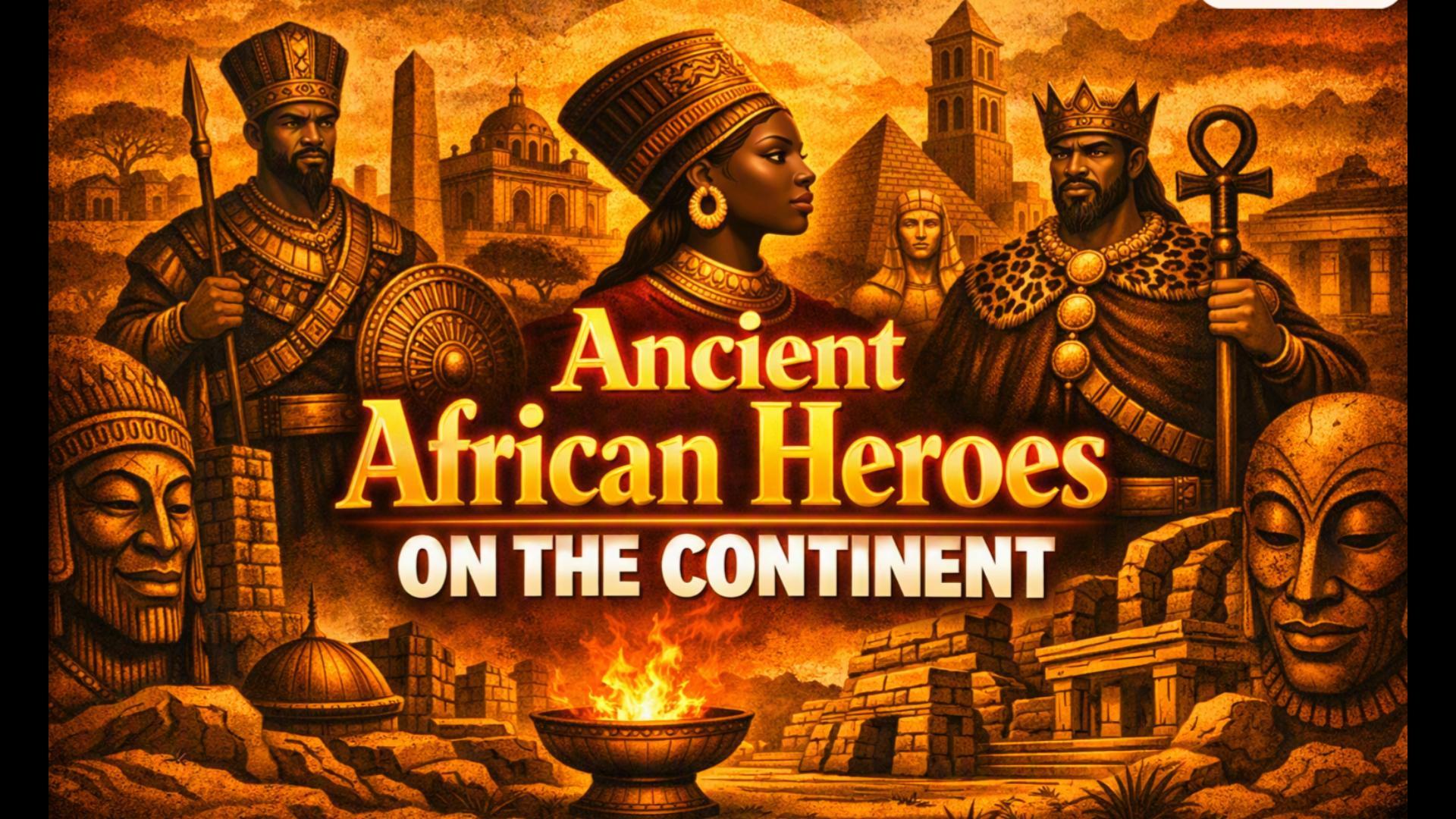

NAME: Queen Nefertiti. The Enigmatic queen of the Nile
COUNTRY: Ancient Egypt in North Africa.
DATE OF BIRTH: Around 1370 BCE (Before Current Era, Or BC – Before Christ)
DATE OF DEATH: Around 1336 BCE (Before Current Era, Or BC – Before Christ), at age about 34.
CAUSE OF DEATH: Unknown.
BURIAL: Unknown. Although many royal mummies have been discovered, Queen Nefertiti’s mummy has never been conclusively identified.
OCCUPATION: Great Royal Wife of Pharaoh Akhenaten, Queen of Ancient Egypt, influential royal figure, religious reformer, and cultural icon.
SUPERVISOR/EDITOR: Harry Agina.
———————–
Hello, I’m Asmau Suleiman, and this is the Afro-Scope Project, where Africa remembers her own. Some heroes conquered kingdoms…
Some built empires…
Some led revolutions…
And then there are those whose greatest legacy is not the land they ruled, but the history they shaped.
Long before cameras, long before written biographies, and more than three thousand years before the modern world knew her name, one African queen left behind a face that time could not erase. She was NEFERTITI. Her name means, “The Beautiful One Has Come.” It is a name that has echoed across millennia.
Yet behind that beauty stood a woman of remarkable influence, intelligence, and mystery—a queen whose life became inseparable from one of the most dramatic chapters in the history of Ancient Egypt.
Nefertiti was born around 1370 BCE, although neither her exact birth date nor her parentage is known with certainty. Historians have proposed several theories about her family, but no single explanation has been conclusively proven. Rather than diminishing her story, these uncertainties remind us how much of the ancient world still waits to be fully understood.
She married Pharaoh Amenhotep IV, who would later change his name to Akhenaten after introducing sweeping religious reforms. Together they became one of the most famous royal couples in Egyptian history.
They had six daughters and ruled during the Eighteenth Dynasty, a period of extraordinary wealth, artistic achievement, and political influence.
But history remembers them for something far greater. Akhenaten challenged centuries of Egyptian religious tradition by elevating the worship of Aten, represented by the radiant solar disk. A new royal capital, Akhetaten—known today as Amarna— was established to serve as the center of this religious transformation.
Whether one agrees with the reforms or not, they marked one of the most remarkable experiments in religious history. Nefertiti stood beside her husband throughout this extraordinary period, not as a silent observer, but as one of its most visible and influential figures.
Unlike many queens before her, Nefertiti occupied an exceptional place in Egypt’s official royal art. Royal art was far more than decoration. In Ancient Egypt, statues, temple reliefs, painted walls, inscriptions, and sculptures recorded how rulers wished to be remembered. They communicated authority, religious belief, royal duty, and national identity.
In these official works, Nefertiti appears performing ceremonies, presenting offerings to the Aten, standing beside the Pharaoh almost as his equal, and in some scenes even striking Egypt’s enemies—a role traditionally reserved for kings themselves.
These remarkable images have led many historians to conclude that she exercised influence far beyond the customary role of a queen. Some scholars even suggest that she may later have ruled as co-regent or under the royal name Neferneferuaten, meaning “Beautiful are the Beauties of Aten.” Others disagree, and the evidence remains the subject of scholarly debate.
This uncertainty is part of what makes Nefertiti so fascinating. History gives us certainty where it can. Where certainty is impossible, it invites careful curiosity instead.
Among all the treasures of Ancient Egypt, none has made Nefertiti more famous than her magnificent painted limestone bust. A bust is a sculpted portrait showing the head, neck, shoulders, and upper chest of a person. Unlike a full statue, it focuses attention on the face and expression.
1345 BCE, long before Jesus Christ was born, the Egyptian royal sculptor Thutmose created Nefertiti’s bust in his workshop at Amarna. More than three thousand years later, archaeologists discovered it almost perfectly preserved. Today it is regarded as one of the greatest masterpieces of ancient art ever found.

It is through this extraordinary sculpture that millions of people around the world have come to know the face of Nefertiti. Yet one of history’s greatest ironies remains. The queen’s portrait survived. Her tomb did not.
Although many royal burials have been uncovered, Nefertiti’s final resting place has never been conclusively identified. Her mummy has never been positively confirmed, and historians still debate what became of her during the final years of the Amarna Period.
Did she die before Akhenaten?
Did she continue ruling under another royal name?
Did she become the mysterious Neferneferuaten?
Or does her tomb still lie hidden beneath the Egyptian sands?
For now, history keeps those answers to itself. But uncertainty does not diminish greatness.
The monuments, inscriptions, reliefs, royal records, archaeological discoveries, and the famous bust together leave no serious doubt that Queen Nefertiti was a real historical figure whose influence reached the very heart of one of Africa’s greatest civilizations.
Queen Nefertiti did not become famous because she conquered distant kingdoms with armies. She became famous because she stood at the centre of a transformation that changed the religious, artistic, and political landscape of Ancient Egypt, while demonstrating a level of royal authority rarely granted to women of her time.
Her image became timeless…
Her story became immortal…
Her mystery became eternal…
She was a queen whose face survived when her tomb did not. Her name disappeared from history, but her image conquered the world. The woman herself remains a mystery. But the queen they could not erase still looks back at us more than three thousand years later.

For her extraordinary influence upon one of Africa’s greatest ancient civilizations, her enduring legacy in art and history, her remarkable position as one of the most recognizable queens the world has ever known, and the timeless mystery that continues to inspire historians, archaeologists, and admirers alike, Queen Nefertiti takes her rightful place in the African Heroes Hall of Fame.
This has been the African Heroes Hall of Fame…
Because history celebrates many heroes…
Africa remembers her own.
**********
**********

COUNTRY: Mali Empire in West Africa.
DATE OF BIRTH: Around 1217 AD.
DATE OF DEATH: Around 1255 AD, at about age 38.
CAUSE OF DEATH: Unknown, believed to have died of natural causes.
OCCUPATION: Founder of the Mali Empire, military leader, and emperor.
SUPERVISOR/ EDITOR: Harry Agina.
————————
Hello, I’m Asmau Suleiman, and this is the Afro-Scope Project, where Africa remembers her own.
History remembers those who won kingdoms. Africa also remembers those who built civilizations.
Imagine a child who many believed would never walk, yet who would one day rise to establish one of the greatest empires in African history…
That child was Sundiata Keita.
Born around 1217, Sundiata was the son of King Maghan Kon Fatta of Kangaba. According to the rich oral traditions preserved by West African griots, he overcame physical challenges in childhood before growing into a courageous leader whose determination would change the course of history.
In the early thirteenth century, the Mandinka people faced political instability and the domination of the powerful Sosso Kingdom. Sundiata united divided clans and forged alliances among neighboring peoples, inspiring them with a vision of freedom and unity.
His defining moment came in 1235 at the Battle of Kirina, where he defeated the Sosso ruler, Soumaoro Kanté. That victory laid the foundation for the Mali Empire, which would grow into one of the greatest and most influential empires in African history.
Yet Sundiata’s greatest achievement was not simply winning a battle…
It was building a nation.
Under his leadership, Mali became known for political stability, flourishing trade, agricultural prosperity, and cooperation among its diverse peoples. His reign established institutions and traditions that would support generations of rulers, including his celebrated successor, Mansa Musa.
His vision of justice and good governance is also associated with the Kouroukan Fouga, a charter remembered in Manding oral tradition for setting out principles of governance, social organization, and mutual responsibility.
Heroes are not remembered because they inherit greatness…
They are remembered because they create it.
Sundiata Keita transformed adversity into unity and laid the foundations of an empire whose legacy still echoes across Africa and the world.
This has been the African Heroes Hall of Fame…
Because history celebrates many heroes…
Africa remembers her own.
**********
**********

DATE OF BIRTH: Around 1280 AD.
DATE OF DEATH: Estimated at 1337 AD at about age 57.
CAUSE OF DEATH: Natural cause.
OCCUPATION: Emperor Of Mali In West Africa, for 25 years.SUPERVISOR/EDITOR: Harry Agina
—————-Hello, I’m Asmau Suleiman, and this is the Afro-Scope Project, where Africa remembers her own. History remembers those who conquered lands. Africa also remembers those who transformed knowledge, commerce, and civilization. Imagine an emperor so wealthy that when he journeyed across continents, entire economies felt his presence. Imagine a ruler whose name appeared on medieval world maps, whose cities attracted scholars from distant lands, and whose empire became a symbol of African greatness. That emperor was Mansa Musa.
 Mansa Musa ruled the Mali Empire during the fourteenth century, inheriting the great empire founded by Sundiata Keita. Under his leadership, Mali grew into one of the wealthiest and most influential empires the world had ever known. Its riches came not from legend, but from abundant gold, thriving trade routes across the Sahara, and a well-organized administration. Merchants, scholars, and travelers journeyed from distant lands to the cities of Mali, where commerce and learning flourished together. Under Mansa Musa, Mali Empire reached and extraordinary height of power and influence, extending across a vast portion of West Africa and controlling or influencing major territories and trading centers across the region. As a ruler of the Keita dynasty founded by Sundiata Keita, Mansa Musa inherited and strengthened one of Africa’s greatest medieval empires, transforming its wealth, political influence, and intellectual reputation into a legacy known far beyond the continent.
Mansa Musa is widely regarded as one of the wealthiest rulers in human history. While it is impossible to measure and compare the wealth of rulers who lived centuries apart with complete accuracy, there is little doubt that the prosperity of his empire and the impact of his wealth made him one of history’s most extraordinary monarchs. In 1324, Mansa Musa went on a pilgrimage to Makkah, one of the most remarkable journeys ever recorded. Traveling with a vast caravan that included thousands of attendants and large quantities of gold, he displayed not only the wealth of his empire but also its importance in the wider world. His generosity became legendary. Historical accounts describe him giving away so much gold along his route that its abundance affected local markets for years. Whether remembered through exact figures or enduring tradition, the journey announced to the world that Africa was home to one of history’s greatest civilizations. His fame spread so widely that European mapmakers began placing him on medieval maps, often portraying him seated upon a golden throne or holding a magnificent piece of gold. To much of the known world, Mansa Musa became the very image of African wealth, influence, and royal splendor.

Yet Mansa Musa’s greatest achievement was not his wealth. He invested in knowledge. He encouraged Islamic scholarship, welcomed learned men to his empire, and supported the construction of mosques, schools, and centers of learning. Under his reign, the city of Timbuktu became more than a thriving commercial center—it became a beacon of knowledge. Students, judges, theologians, scientists, and merchants crossed deserts to study, teach, and exchange ideas. It stood as living proof that Africa’s greatness was measured not only in gold, but also in learning, culture, and civilization. His reign demonstrated that true greatness is measured not merely by what a leader possesses, but by what a leader builds for future generations. Today, Mansa Musa remains a timeless symbol of visionary leadership, prosperity, and the pursuit of knowledge. Gold made Mansa Musa famous. Wisdom made his empire enduring. His greatest inheritance was not the treasure he carried across deserts, but the civilization he built for generations yet unborn. This has been the African Heroes Hall of Fame. Because history celebrates many heroes… Africa remembers her own.
**********
**********

COUNTRY: South Africa in Southern African region.
BIRTH DATE: Around 1787.
DEATH DATE: 22 September 1828, at about age 41.
CAUSE OF DEATH: Assassinated by his half-brothers, Dingane and Mhlangana, with the assistance of Mbopa.
OCCUPATION: King of the Zulu Kingdom, military commander, and nation-builder.SUPERVISOR/EDITOR: Harry Agina
——————–Hello, I’m Asmau Suleiman, and this is the Afro-Scope Project, where Africa remembers her own.
History remembers many kings. Africa also remembers those who transformed the destiny of their people.Long before the colonial partitioning of Africa, one remarkable leader transformed a small chiefdom into one of Southern Africa’s most formidable kingdoms. Through military innovation, rigorous discipline, and extraordinary leadership, he reshaped the political landscape of an entire region.That leader was Shaka Zulu.Born around 1787, Shaka rose to become King of the Zulu Kingdom during a period of intense competition among communities in Southern Africa. Possessing exceptional vision and determination, he united scattered Zulu clans into a disciplined and powerful kingdom.Shaka revolutionized warfare in the entire southern African region. He refined traditional weapons, popularized the short stabbing spear for close combat, strengthened the use of large shields, and developed disciplined military formations that changed the way battles were fought. His leadership transformed the Zulu army into one of the most respected fighting forces in African history. Shaka revolutionized warfare through bold military reforms and innovative battlefield tactics. He popularized the short stabbing spear, known as the iklwa, replacing the older style of long-distance spear throwing with close-quarters combat. He also trained his warriors to use their large cowhide shields not only for protection but to hook an opponent’s shield aside before striking decisively.Most famously, he perfected the “Buffalo Horns” (impondo zankomo) battle formation.


 In this strategy, the experienced warriors formed the “chest”, engaging the enemy head-on while holding them in place. At the same time, two fast-moving “horns” swept around both flanks to encircle the opposing force. Behind them stood the “loins,” a reserve force ready to reinforce the attack wherever needed or pursue retreating enemies.This combination of discipline, speed, surprise, and encirclement transformed the Zulu army into one of the most formidable fighting forces in African history.Decades after Shaka’s death, these military innovations continued to shape Zulu warfare and contributed to the Zulu army’s remarkable ability to challenge well-equipped European forces during battles such as the Battle of Isandlwana in 1879.
His influence reached far beyond the battlefield. By strengthening political unity and central authority, he laid the foundations of a kingdom whose reputation spread across Southern Africa and whose history continues to be studied around the world. His rise, however, was not without conflict. Some communities accepted Zulu leadership, while others resisted, leading to wars, migrations, and profound social change throughout the region. Historians continue to debate how much of this wider upheaval can be attributed directly to Shaka and how much resulted from broader political, economic, and environmental forces already shaping Southern Africa.Heroes are not remembered because they were perfect. They are remembered because they changed history. Shaka Zulu did exactly that. His military innovations, nation-building, and enduring influence secured his place among the greatest figures in African history. Nearly two centuries after his death, his name continues to inspire admiration, scholarship, and discussion across the continent and beyond.History celebrates many heroes… Africa remembers her own.
**********
**********

COUNTRY: Nigeria in West Africa.
DATE OF BIRTH: Around 1821.
DATE OF DEATH: July 7, 1891, at approximately 70 years of age.
CAUSE OF DEATH: The exact cause of King Jaja’s death is not known and remains a subject of historical debate.
OCCUPATION: King of the Kingdom of Opobo from 1870 until his exile in 1887, Merchant in Palm oil, Political leader.
SUPERVISOR/EDITOR: Harry Agina.
———————–
Hello. I am Josiah Onesimus Haruna. I am here to tell you about a Nigerian king who challenged the British empire during the days of European colonialism in Africa.
King Jaja of Opobo: The Inspiring Story of Nigeria’s Legendary Merchant King
Discover the remarkable story of King Jaja of Opobo, the Nigerian merchant king who rose from slavery to become one of Africa’s greatest rulers and defenders of economic independence.
History is filled with extraordinary individuals who changed the course of nations, but few stories are as inspiring as that of King Jaja of Opobo. Rising from the unimaginable hardship of slavery, Jaja built a thriving kingdom, became one of West Africa’s most successful merchants, and boldly defended his people’s economic independence against British colonial interests.
His life is more than a chapter in Nigerian history, it is a powerful lesson in resilience, leadership, entrepreneurship, and the pursuit of freedom. More than a century after his death, King Jaja remains one of Nigeria’s most celebrated historical figures and a symbol of African excellence.
WHO WAS KING JAJA OF OPOBO?
King Jaja of Opobo, originally named Mbanaso Okwaraozurumba, was born around 1821 in what is now Abia State, Nigeria. He belonged to the Igbo ethnic group before being captured during the regional conflicts that fueled the Atlantic slave trade.

As a young boy, he was sold into slavery and taken to the Kingdom of Bonny in the Niger Delta in Nigeria. Although his circumstances were harsh, Jaja quickly distinguished himself through intelligence, discipline, and an exceptional understanding of commerce.
His owner, Chief Alali, recognized his talents and entrusted him with increasing responsibilities. Over time, Jaja earned his freedom and rose through Bonny’s trading hierarchy to become one of its most influential merchants.
His remarkable journey from enslaved child to respected businessman remains one of the greatest success stories in African history.
THE FOUNDING OF THE KINGDOM OF OPOBO:
By the late nineteenth century, political disagreements and competition over trade created tensions between Jaja and the leadership of Bonny.
Rather than remain in conflict, Jaja chose a bold path. In 1870, he led thousands of followers to establish the Kingdom of Opobo, strategically located along key waterways in the eastern Niger Delta. Thanks to its favorable location and Jaja’s business expertise, Opobo quickly became one of the region’s most prosperous commercial centers.
Within a few years, merchants from Europe regularly visited Opobo to purchase palm oil, making the kingdom one of the most important trading hubs in West Africa.

BUILDING AN ECONOMIC POWER HOUSE:
During the nineteenth century, palm oil was one of the world’s most valuable commodities. It was used in the production of soap, candles, lubricants, and machinery during Europe’s Industrial Revolution.
King Jaja understood something many leaders overlooked: whoever controlled the trade controlled the wealth. Instead of allowing foreign merchants unrestricted access to producers in the interior, he maintained Opobo’s role as the principal trading gateway. This strategy protected local businesses, strengthened the kingdom’s economy, and generated enormous prosperity for his people. His economic policies transformed Opobo into one of the wealthiest city-states in the Niger Delta. Today, many historians regard King Jaja as one of Africa’s earliest examples of a successful entrepreneur who combined business strategy with political leadership.

KING JAJA’S CONFLICT WITH THE BRITISH
As British colonial ambitions expanded across West Africa, British officials sought direct access to inland markets and wanted to eliminate African middlemen who controlled trade. King Jaja refused to surrender Opobo’s economic independence. His resistance frustrated British trading companies, who viewed his control over commerce as an obstacle to their profits.In 1887, British officials invited King Jaja aboard a naval vessel under the pretense of discussing trade relations peacefully. Instead, he was arrested without warning and accused of obstructing free trade. He was exiled first to St. Vincent in the Caribbean and later allowed to live on the island of Tenerife.

Following public criticism in Britain, the colonial government eventually agreed to allow him to return home. Sadly, King Jaja died in 1891 during the return journey, never seeing his beloved kingdom again.
LEADERSHIP LESSONS FROM KING JAJA:
King Jaja’s legacy extends far beyond politics and commerce. His life offers valuable lessons that remain relevant today.
1. Great Leaders Rise Above Their Circumstances
Jaja’s beginnings did not determine his future. Despite being enslaved as a child, he developed the skills and determination that enabled him to become a king.
2. Vision Creates Opportunity
Instead of remaining trapped in political disputes, he established a new kingdom that became one of the region’s most successful trading centers.
3. Economic Independence Creates Lasting Strength
King Jaja believed Africans should control their own resources and negotiate with foreign powers from a position of strength. His approach remains an important lesson for developing economies today.
4. Integrity Often Comes at a Cost
Jaja refused to compromise the interests of his people, even when confronted by the most powerful empire of his time. His exile demonstrated the price courageous leadership sometimes demands.
WHY KING JAJA IS STILL RELEVANT TODAY:
In modern Nigeria, King Jaja of Opobo is remembered not only as a traditional ruler but also as a visionary entrepreneur and patriot.
HIS STORY CONTINUES TO INSPIRE:
Students learning African history.
Entrepreneurs building businesses.
Leaders seeking examples of principled leadership.
Nigerians celebrating their cultural heritage.
Africans reclaiming stories of innovation, resilience, and self-determination.
His life reminds us that Africa’s history includes visionary rulers, thriving economies, and remarkable achievements long before colonial rule. King Jaja is remembered as a visionary leader, skilled merchant, founder of the Kingdom of Opobo, and a symbol of African resistance to colonial economic domination.
The story of King Jaja of Opobo is one of the most remarkable in African history. From the pain of slavery to the heights of kingship, he demonstrated that determination, wisdom, and strategic leadership can overcome extraordinary obstacles. His unwavering commitment to protecting his people’s prosperity and independence continues to inspire generations of Nigerians and Africans around the world. As we celebrate the heroes who shaped our history, King Jaja’s legacy reminds us that true greatness is measured not only by power or wealth but by the courage to stand for what is right and the vision to build a better future for others.
**********
**********

COUNTRY: Ashanti Empire (Present-day Ghana) in West Africa.
DATE OF BIRTH: Around 1840.
DATE OF DEATH: October 17, 1921, at about 80 years of age.
CAUSE OF DEATH: Natural causes while in exile in the Seychelles.
OCCUPATION: Queen Mother of Ejisu, military leader, stateswoman, and anti-colonial heroine.
SUPERVISOR/ EDITOR: Harry Agina.
——————————
Hello, I’m Asmau Suleiman, and this is the Afro-Scope Project, where Africa remembers her own. History remembers those who inherited power. Africa also remembers those who found courage when their people needed it most. When an empire stood on the brink of humiliation, one woman refused to let its spirit be surrendered. That woman was Yaa Asantewaa.
Born around 1840 in Besease in the Ashanti Empire, Yaa Asantewaa became the Queen Mother of Ejisu, a position of immense responsibility and influence within Ashanti society. Wise, respected, and deeply devoted to her people, she believed that true leadership required not only authority, but also courage when a nation’s future was at stake.
At the close of the nineteenth century, tensions between the Ashanti Kingdom and the British colonial administration reached a breaking point. The conflict intensified when the British Governor, Sir Frederick Hodgson, demanded possession of the Golden Stool, the most sacred symbol of Ashanti unity, identity, and sovereignty.
According to Ashanti tradition, the Golden Stool was not crafted merely as a royal throne. It was believed to have descended from heaven through the prayers of the great priest and statesman Okomfo Anokye during the reign of King Osei Tutu I, founder of the Ashanti Empire. The Stool was believed to embody the soul of the Ashanti nation itself. It belonged not to any king, but to all the Ashanti people—their ancestors, the living, and generations yet unborn. No one, not even the Asantehene, was permitted to sit upon it. It was carried with profound reverence and preserved as the spiritual heart of the nation.

When Governor Hodgson demanded that the Golden Stool be brought before him so that he could sit upon it as a symbol of British authority, the request was received not simply as a political demand, but as a profound insult to the Ashanti people’s identity, traditions, and sovereignty. Rather than surrender their most sacred treasure, Ashanti leaders secretly hid the Golden Stool where it could not be found.
As many leaders hesitated, Yaa Asantewaa rose before the assembled chiefs and delivered words that have echoed through African history: “If you, the men of Ashanti, will not go forward, then we will. We, the women, will fight. We will fight until the last of us falls on the battlefield.” Her courage transformed hesitation into resolve.
In 1900, she assumed leadership of what became known as the War of the Golden Stool, organizing resistance against British forces and directing the defense of Ashanti independence. Although the British eventually prevailed through superior military resources, they never captured the Golden Stool. The sacred symbol remained hidden and survived the conflict, preserving the spiritual identity of the Ashanti nation.
Following the war, Yaa Asantewaa and several Ashanti leaders were captured and exiled to the Seychelles, where she spent the remainder of her life until her death on 17 October 1921. Though separated from her homeland, neither exile nor defeat diminished her legacy.
Years after the war, the hidden Golden Stool was rediscovered by local workers. Although some of its gold ornaments were removed before its sacred significance was fully recognized, the Stool itself survived and was restored to its rightful custodians. Today, it remains one of the most revered cultural and spiritual treasures of the Ashanti people and continues to symbolize their unity, resilience, and identity.
Yaa Asantewaa’s defiance inspired future generations of Africans who struggled for freedom, dignity, and self-determination. She is remembered as one of the last great leaders to organize a major armed armed resistance against British colonial rule in West Africa.
Her story is remarkable not simply because she was a woman who led an armed resistance. It is remarkable because she understood what was truly at stake. The British were not merely seeking possession of a golden object. They were demanding authority over a symbol that represented the very soul of the Ashanti nation. And Yaa Asantewaa refused to surrender it. She knew the odds were against her. She knew that the British possessed greater military resources. She knew that defeat could mean imprisonment, exile, and separation from her homeland.
Still, she stood. Heroes are not always remembered because they won every battle. Sometimes, they are remembered because they stood when others were afraid to move. Yaa Asantewaa did exactly that.
Her greatest achievement was not that she defeated the British. She did not. Her greatest achievement was that she refused to allow fear to determine the fate of her people. She became a symbol of courage at a moment when courage was desperately needed.

The Golden Stool survived. And so did the spirit it represented. Yaa Asantewaa died in exile, far from the land she had fought to defend. She did not live to witness the eventual restoration of Ashanti sovereignty. But her legacy returned home. The woman was taken away. The Golden Stool remained. And the story of the woman who fought to protect it became immortal.

Today, Yaa Asantewaa remains an enduring symbol of African womanhood, leadership, courage, and resistance. Her name lives on in Ghana and throughout Africa. Her story reminds us that women have always stood at the centre of Africa’s history—not merely as mothers, wives, or witnesses, but as leaders, strategists, defenders, and warriors. For her extraordinary courage, her leadership during the War of the Golden Stool, her defense of Ashanti sovereignty, and her enduring legacy as one of Africa’s greatest female resistance leaders, Yaa Asantewaa takes her rightful place in the African Heroes Hall of Fame.
This has been the African Heroes Hall of Fame…
Because history celebrates many heroes…
Africa remembers her own.
**********
**********

COUNTRY: Ethiopia in East Africa.
DATE OF BIRTH: August 17, 1844.
DATE OF DEATH: December 12, 1913, at the age of 69.
CAUSE OF DEATH: Complications following a prolonged illness after suffering several strokes in his later years.
OCCUPATION: Emperor of Ethiopia, military commander, statesman, diplomat, and modernizer.
SUPERVISOR/ EDITOR: Harry Agina.
———————–
Hello, I’m Asmau Suleiman, and this is the Afro-Scope Project, where Africa remembers her own. History remembers those who defended their nations. Africa also remembers those who defended her freedom.
Long before the winds of colonialism swept across the African continent, one emperor stood firm against one of Europe’s most determined colonial ambitions and changed the course of history.
That emperor was MENELIK II.
Born on 17 August 1844, Menelik II rose to become Emperor of Ethiopia at a time when European powers were racing to divide Africa among themselves. While much of the continent fell under colonial rule, Ethiopia faced the same threat—but under Menelik’s leadership, it chose resistance over surrender.

Before he defeated a foreign army, Menelik II first united Ethiopia’s diverse peoples behind a common purpose. He understood that no nation could successfully defend its freedom while divided within itself. His greatest strength was not merely commanding soldiers but inspiring a people to stand together in defense of their homeland.
His defining moment came on 1 March 1896 at the Battle of Adwa, where Ethiopian forces achieved a decisive victory over the invading Italian army. Through careful planning, national unity, strategic leadership, and the courage of tens of thousands of Ethiopian soldiers, Menelik II preserved Ethiopia’s independence and dealt one of the greatest defeats ever suffered by a European colonial power in Africa.
Standing beside him was Empress Taytu Betul, a formidable leader whose wisdom, patriotism, and unwavering resolve strengthened Ethiopia’s resistance. She firmly opposed colonial concessions, helped mobilize support for the defense of the nation, and remains one of the great heroines of Ethiopian history. Together, they demonstrated that the defense of a nation is strongest when courageous leadership is shared.

The victory at Adwa echoed far beyond Ethiopia’s borders. It became a powerful symbol of African resilience and inspired anti-colonial movements across the continent and among people of African descent around the world. At a time when many believed European conquest was inevitable, Ethiopia proved that African determination, organization, and leadership could successfully resist imperial expansion.
Yet Menelik II’s greatness extended beyond the battlefield. He recognized that a strong nation required more than military success. A skilled diplomat as well as a warrior, Menelik understood that lasting strength came from balancing courage with wisdom. He negotiated with foreign powers, acquired modern technology and equipment, and navigated complex international relationships while fiercely protecting Ethiopia’s sovereignty. His diplomacy became as important to Ethiopia’s survival as his victories in war.
During his reign, Ethiopia embraced important reforms that strengthened the state. Roads were improved, the first railway connecting Addis Ababa to the port of Djibouti began transforming transportation and trade, modern schools were encouraged, hospitals were established, diplomatic relations expanded, and systems of communication such as the telegraph were introduced. Under his leadership, Ethiopia entered a new era while preserving its independence.
Menelik also founded Addis Ababa, which grew into Ethiopia’s capital and remains one of Africa’s most important political and diplomatic cities. Today it serves as the headquarters of the African Union, symbolizing Ethiopia’s enduring place at the heart of African affairs.


COUNTRY: Nigeria in West Africa.
DATE OF BIRTH: 1793.
DATE OF DEATH: 1864, at about age 71.
CAUSE OF DEATH: Believed to have died of natural causes.
OCCUPATION: Scholar, educator, poet, linguist, and women’s education advocate in the Sokoto Caliphate.
SUPERVISOR/EDITOR: Harry Agina.
———————–
Hello, I’m Asmau Suleiman, and this is the Afro-Scope Project, where Africa remembers her own.
History celebrates those who conquered kingdoms. Africa also remembers those who enlightened minds. Centuries before the modern campaign for women’s education and liberation, one remarkable African woman was already proving that knowledge could transform societies. That woman was NANA ASMAU.
Born in 1793 into the distinguished scholarly family of Usman dan Fodio, Nana Asma’u grew up in an environment where learning, scholarship, and public service were deeply valued. Women, as well as men, were encouraged to pursue knowledge, providing the foundation upon which her extraordinary intellect flourished.

Yet Nana Asma’u refused to let education remain the privilege of a fortunate few. She became one of the most accomplished intellectuals of nineteenth-century West Africa—an educator, poet, linguist, and teacher whose influence reached far beyond the walls of her home.
Through a remarkable network of trained women educators, she carried learning into towns, villages, and rural communities, ensuring that women from all walks of life gained access to education, moral guidance, and practical knowledge. In doing so, she strengthened families, empowered communities, and demonstrated that educating women was essential to building a prosperous society.
Fluent in several languages and blessed with an exceptional literary gift, Nana Asma’u preserved knowledge through poetry and scholarship, making learning memorable, accessible, and enduring. Her writings continue to be studied today as remarkable contributions to African intellectual and literary history.
Yet Nana Asma’u’s greatest achievement was not simply the knowledge she possessed. It was the knowledge she shared. She proved that the greatest revolutions are not always fought with weapons. Some are won with wisdom, compassion, and education.

Heroes are not remembered only for the battles they fought.
They are remembered for the lives they transformed. Nana Asma’u transformed generations. Her lifelong commitment to scholarship, education, and the empowerment of women established a legacy that continues to inspire educators, scholars, and leaders across Africa and beyond.
Some people inherit greatness…
Heroes multiply it….
Nana Asma’u transformed privilege into purpose—and purpose into a legacy that still educates Africa today.
This has been the African Heroes Hall of Fame….
Because history celebrates many heroes…
Africa remembers her own—
ASMAU SULEIMAN