

October 20, 2026
Greetings from the Afro-Scope etymology team of Harry Agina and Asmau Suleiman. We welcome you to our AfroLinguistic Etymology series. If you’re a fan of Afro-Scope, then you’re already aware of the mandate of this series to inform you of words of African languages that have made their way into mainstream English dictionaries. If you didn’t know, now you do.
On September 25, 2026, we informed you about the journey of the word BONGO into mainstream English dictionaries. The origin of the word is Africa, and it is the name of a music instrument, which was popularized globally by Cuban music.

What we didn’t inform you then was that Bongo identifies more than a music instrument. This is the day to augment our information, the day to tell you about another BONGO, the one with horns.This is where I bring in my gorgeous philosophically poetic or poetically philosophical colleague, Asmau Suleiman. She will take you on the journey of our second BONGO out of Africa, and the story of the element that bears the name:
Hello good people. I am Asma’u Suleiman with another story of BONGO, the one with horns. All you do to get to our first Bongo etymology right here on this site is search for the word “Bongo,” and you have it.
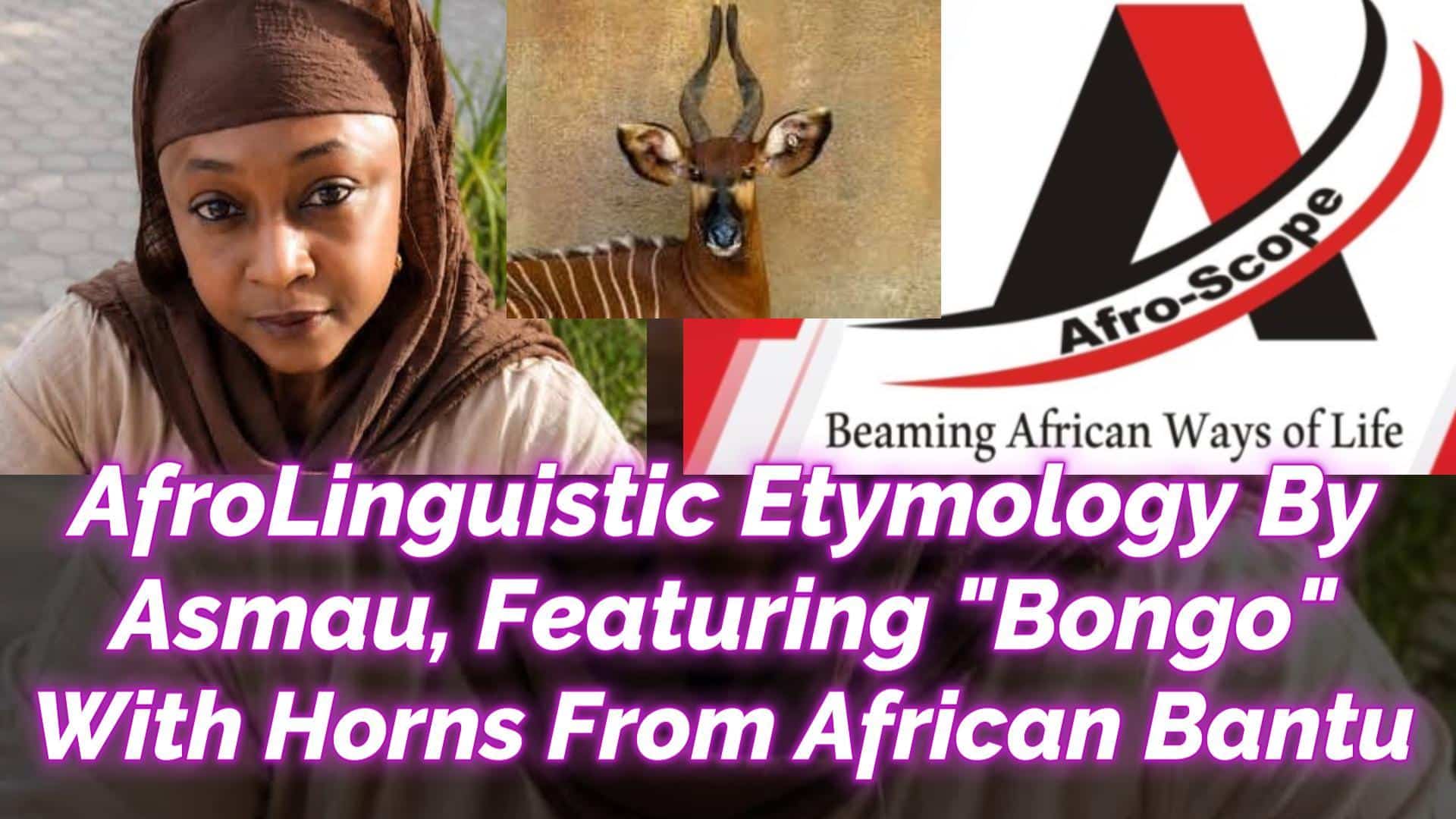
So, yes, Bongo is back, only this time, it comes with horns. And not just any horns. Bongo is a remarkable antelope of the forests of tropical and central Africa, with a rich reddish-brown coat marked by striking white stripes and large, spirally twisted horns.

But here comes the surprise. This particular Bongo was at the destination first. Long before the Bongo that arrived with a musical beat in mainstream dictionaries, this bongo was already an English word for an African animal.
Dictionary sources date the antelope sense to around 1860 to 1865. The drum sense came later, around 1915–1920. So the Bongo we met in our last story—the one we heard before we saw—was actually the younger Bongo.
The antelope had already entered the English ddictionaries decades earlier. And its own linguistic trail leads directly into Africa.
Major dictionaries give the animal’s name as probably coming from a Bantu language, with American Heritage specifically comparing it with Lingala mongu, meaning “antelope.”
So while the exact linguistic path is expressed cautiously in the dictionaries, the African connection is much clearer here than it is for the drum.
And then there is the animal itself. The bongo is a forest antelope. It is built for a life beneath trees rather than out on open grassland. Its coat is reddish-brown, crossed by narrow white stripes that break up its outline among the vegetation. And rising from its head are those magnificent horns—spirally twisted and carried by both males and females.

There is something almost unexpected about seeing one. At first glance, the stripes might make you think of another African animal. But then the horns tell you: No. This is Bongo.
And there is another fascinating distinction. The name bongo is not simply a nickname invented for an exotic animal after it reached English. The word itself came into English as the name associated with the African antelope, carrying an African linguistic trail with it.
And so, when the word eventually appeared again in another form—as the name of a pair of drums—English speakers encountered Bongo for the second time…
One Bongo had horns…
The other had rhythm…
One belonged to the forests of Africa…
The other would travel through Cuba and across the world of music.
And yet they arrived in English wearing exactly the same name. That is where our two stories meet. Not because we are claiming that the antelope named the drum…
Not because the two words must share one linguistic ancestry…
But because the same sound now carries two different journeys…
One through the forest…
One through music.
And if we began with the drum, we might have thought Bongo was a word born to rhythm…
But now we know better…
Bongo was already walking through the African forest long before the world heard the drums…
A word…
An antelope…
A name that crossed into English from Africa.
And a second Bongo that would later cross oceans through music…
Two Bongos…
Two journeys…
One word that makes us look twice…
Bongo!
And this time, Bongo doesn’t need a beat…
He has horns.
That is the beauty of etymology. Sometimes, the word you think you have just discovered has been waiting for you in the forest all along.
Keep speaking Africa, even when you don’t know you are…
Until next time.