

August 20, 2026
Greetings!
I am Harry Agina, the CEO of the Afro-Scope Project, here with the very first story ever published in the Sports Category of our Afro-Scope website. It is about the game of football in Africa. Mind you, whereas this game is called football in most countries of Africa and Europe, it is known as soccer in America, Canada, Australia, New Zealand, South Africa, Ireland, and some other countries.
Now, to the football (soccer) story. It’s a thriller written by an Octogenarian, Elder Chris Ngwu. In his active professional days, Chris was a broadcaster with Nigeria’s “National Television Authority (NTA).” He was mostly a reporter of great repute at Nigeria’s federal State House in Abuja, the capital city of Nigeria.
His story is about a Nigerian football (soccer) legend, Balogun, who in various ways can be compared to Pele, the Brazilian legend. Balogun went into professional footballing in 1948, about eight years before Pele who started in 1956. The story of Balogun should interest African youngsters, Nigerians in particular, who are so much in love with football (soccer) today. He was a trailblazer in the game who made Africa proud in the global community long before the appearance of today’s football (soccer) stars who they are so proud of.
Now, here’s Chris with a brief story about Teslim Balogun, Nigeria’s 20th century legend of football:
Hello. I am Chris Ngwu, with the story of a 20th century Nigerian legend of football named Teslim Balogun.

“George nwam o, ejekwena maka Balogun,” is a phrase of the Igbo language of Nigeria in West Africa. Translated to English, it reads: “George my son o! Do not go, because Balogun is there.” That was a mother advising her son George, a football (soccer) goalkeeper in the 20th century Nigeria in West Africa. The ‘o’ after ‘son’ in mama’s advice was an exclamation sound of fear, a warning that her goalkeeper son, George Onyemezie, who was on his way to a football match, was in danger of possible death.
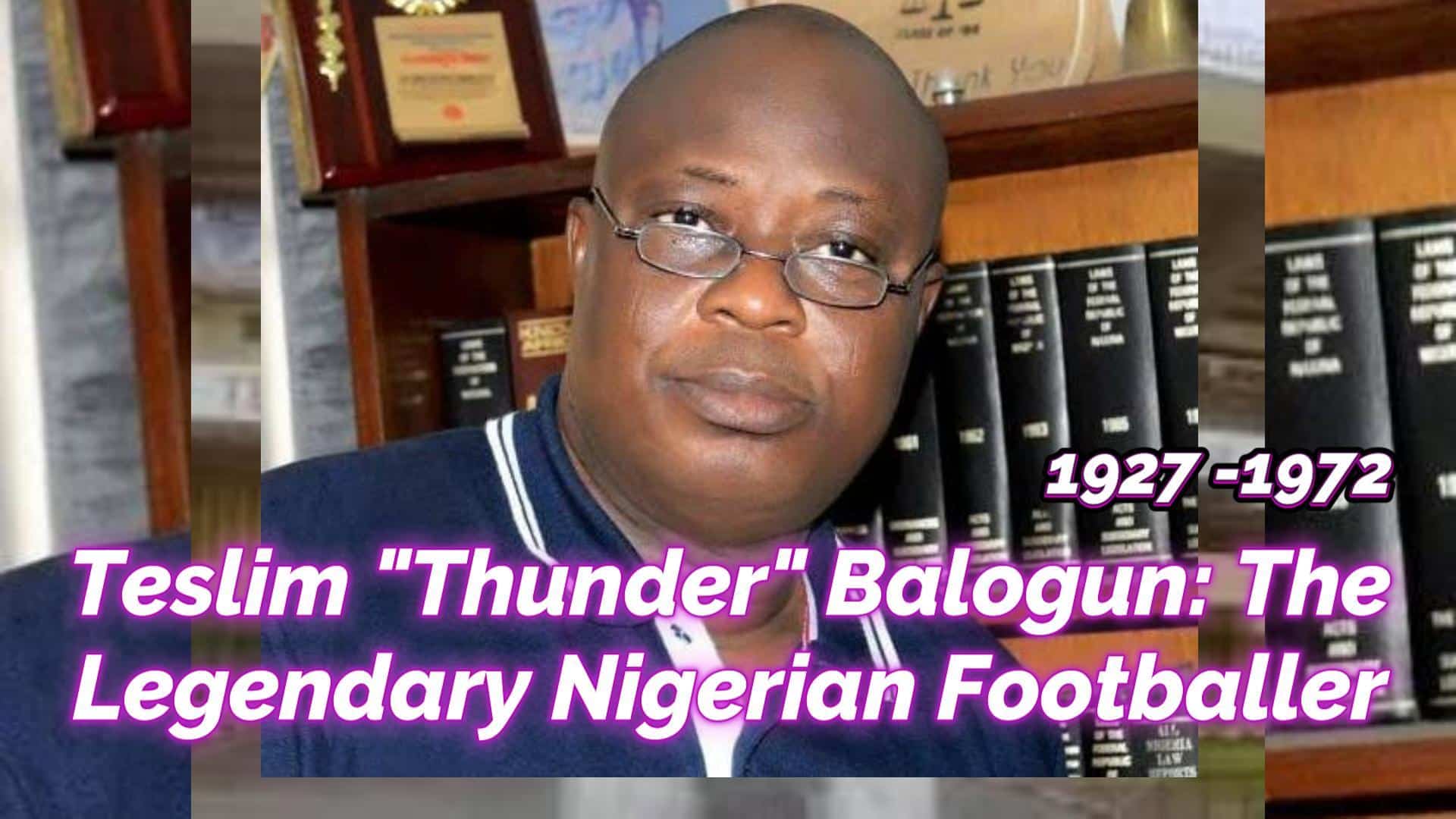
The danger that mama feared for her football (soccer) goalkeeper son, George, was a legendary Nigerian footballer, Teslim Olawale Ayinde Balogun. Balogun was the striker for the football team against which the team of George the goalkeeper was on his way to play. Teslim Balogun the striker was nicknamed “Thunder” because his shot was so terrific. Legend has it that Balogun’s thunderous shot was liable to tear through goalpost nets and could be deadly to goalkeepers. So, mama didn’t want her goalkeeper son to participate in the impending football match. She was afraid that the dreaded “Thunder” Balogun would kill her son with one of his thundering strikes.

The scene happened at the Zaria Railway Station in Zaria, northern Nigeria, in the 1950s. The Kano Football Association team, otherwise called X1, was heading by train for Lagos in southwest Nigeria, and had stopped at the Railway station for a short break. Passenger trains in those days used to stop for a while at different railway stations en route the final destinations of their journeys. For instance, passenger trains from Kano to Lagos would stop in Zaria, Kaduna, Minna, Offa, Ibadan for about 30 minutes. At each stop, they dropped passengers, picked up new passengers, and gave the train drivers and ticketing officers time for refreshment. It was at this journey break time that George Onyemezie’s mother, a Zaria resident went to plead with her goal keeper son not to continue the journey to Lagos. The Kano X1 football team was to meet a Lagos team that had the much dreaded Teslim “Thunder” Balogun in its line up.
But George, a highly rated and respected goalkeeper in the then Northern Nigeria, pleaded with his mother not to be scared by the story of Balogun’s killer shots and that he, George was well prepared for the match. George’s mother left for home from the Zaria Railway station broken hearted and sobbing intermittently. The team went to Lagos, played their matches with George unscathed. The Kano X1 was the first football team from outside Lagos to win the prestigious Governor’s Cup, which was later named “Challenge Cup.”
For many years later, the words of George Onyemezie’s plea to her son, were mimicked to mockingly taunt the siblings of George Onyemezie in Zaria.
Tesilim “Thunder” Balogun started his career in 1948 as a footballer, long before the game started rewarding players and turning many into millionaires. He played for various clubs such as UAC XI, Apapa Bombers, Railway XI, Dynamos Club, and more. Thunder Balogun became the first Nigerian to play professionally in England with Queens Park Rangers (QPR).
When Teslim “Thunder” Balogun left the field as a player, he graduated into a professional football coach. The new career started when he returned to Nigeria after his adventure with Queens Park Rangers (QOR) football Club of England. He completed his professional coaching qualifications, and became the first African to become a professional football (soccer) coach. He led the Nigerian football squad at the 1968 Mexico City Olympics. It was the first Olympic game Nigeria ever participated in. In its very first match, Thunder Balogun’s team defeated Japan by one goal to zero.

Sadly, Thunder Balogun died in 1972 at a very unripe age of 41 years. In his honor, the Surulere state-owned stadium (opposite the current National Stadium) was renamed the Teslim Balogun Stadium, after it was revamped by the Lagos State Government.
