

September 10, 2026
Greetings!
I am Harry Agina, introducing another edition of Afro-Scope’s AfroLinguistic Etymology series. Our last edition was about a word of culinary value to the world— OKRA. And of course, you can easily find that edition right here on this site if you missed it.
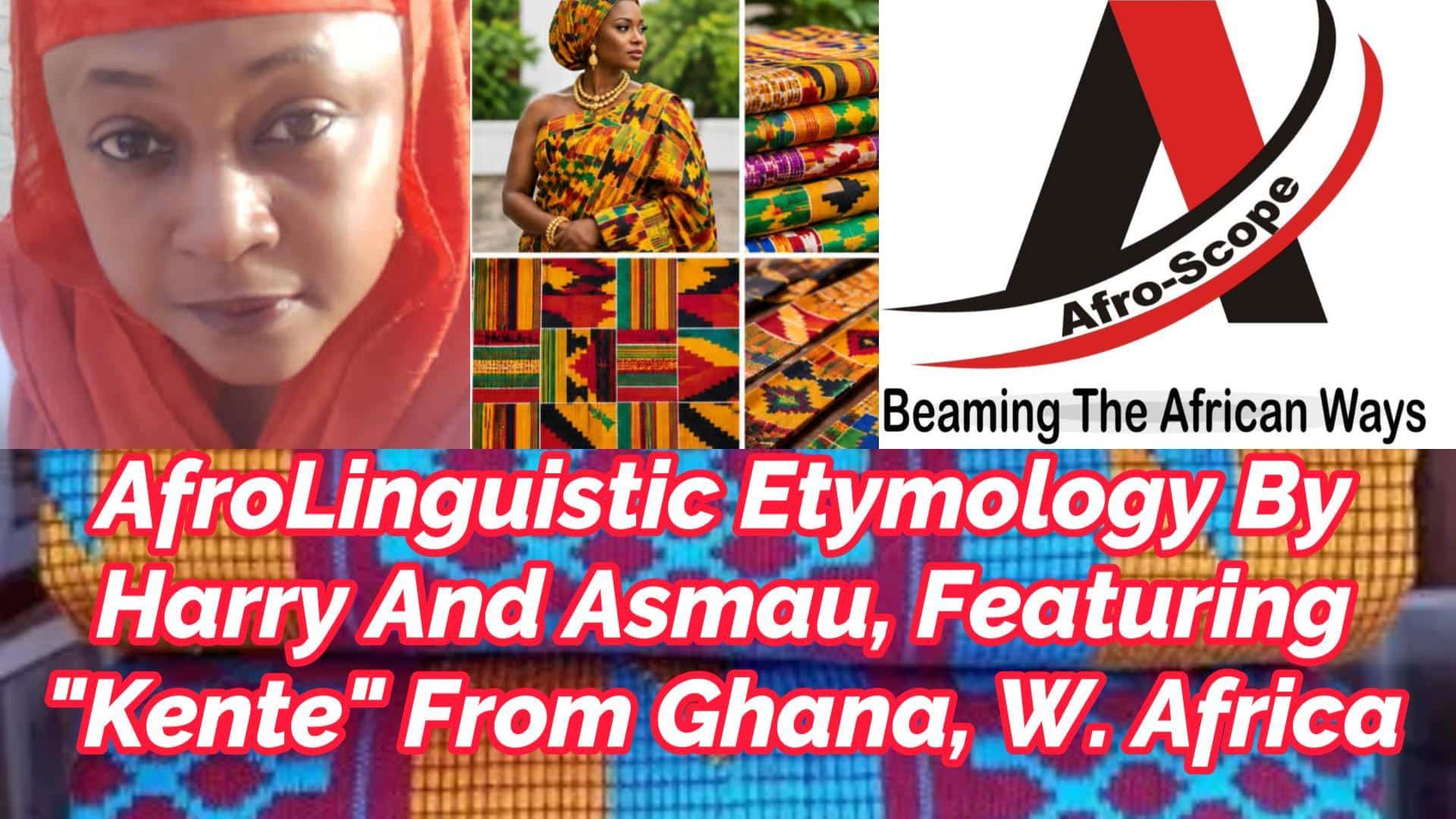
Today’s edition is about a word with textile values to the world. However, we’re going to use one stone to kill two birds for you. The first bird is the AfroLinguistic Etymology of the word. The second bird is African Fashion that is made out of the product that bears the word as a name. I speak of KENTE, a word which names the most uniquely colorful and richly patterned woven textile products that the world has ever seen. Importantly, Kente the textile fabric is more than a fabric. It is a national symbol of the country of Ghana in West Africa.

Now, it’s time to bring in my colleague, the gorgeous poetically philosophical or philosophically poetic etymologist, Asmau Suleiman. She will take us through the rest of this journey of etymology of the word into mainstream dictionaries of the world. It was piloted by the fabric that bears the name. Here’s Asmau for you:
Hi. I’m Asma’u Suleiman with today’s Afro-Scope AfroLinguistic Etymology. Some words travel through language…
Some travel through people…
And some are carried by things people make with their hands. Today, we are following one of those words for something that people make with their hands…
KENTE— The Word That Was Woven Into World Dictionaries.
KENTE, a name now known around the world for a distinctive, richly patterned colorful woven textile made in Ghana, West Africa. But before we admire the colors, let us investigate the word. Kente has a story. Like many old African words, the story is not quite as simple as it first appears.
The word Kente is recorded in English dictionaries as the name of a colorful handwoven cloth from Ghana. Historical records, however, take us much further back.
Nineteenth-century Akan and Ewe sources contain forms such as kente and kete, showing that the word and the textile belong to a much older West African linguistic and weaving history.
And here, Afro-Scope Investigates. You may have heard that kente comes from the Akan word kɛntɛn, meaning “basket,” supposedly because the interwoven appearance of the cloth resembles a basket.

It is a popular explanation. But it is not an etymology we should present as settled fact. Historical scholarship shows that the terminology appears in both Akan and Ewe-speaking areas of Ghana, while different traditions preserve different accounts of the cloth’s history and name.
So, rather than forcing one answer, we follow the evidence. And the evidence leads us into the remarkable weaving traditions of Ghana and the wider West African region.
Kente is traditionally woven in narrow strips, which are then joined together to create larger pieces of cloth.

Among the Asante tribe people of Ghana, Kente became closely associated with royalty, ceremony, status and prestige. And, among the Ewe people, particularly in Ghana and neighboring Togo, there is also a long and highly developed Kente weaving tradition, with its own designs, techniques and cultural meanings.
The patterns are not merely decoration. Colors, motifs and arrangements can carry messages. The cloth can communicate identity, occasion, status, history and values.
In other words, Kente does not merely cover the body.
It can speak. And that is where this beautiful textile begins to travel beyond the loom. Kente became increasingly visible as a symbol of Ghanaian identity and African cultural pride, particularly during the twentieth century.

As Ghana emerged as an independent nation in 1957, Kente acquired even greater international visibility. It appeared in political, ceremonial and cultural spaces, and its association with African identity helped carry it far beyond the communities that originally wove it.
Then the journey widened. Kente crossed oceans. It entered African American cultural life. It appeared at graduations, celebrations, ceremonies and important moments of identity and achievements. And today, Kente is recognized far beyond Ghana.
In 2024, UNESCO inscribed the craftsmanship of traditional woven textile Kente on the Representative List of the Intangible Cultural Heritage of Humanity.

A textile born from specialized African weaving traditions had become part of humanity’s recognized cultural heritage. And suddenly, the word we began with has travelled quite a distance.
From West African looms to royal courts…
From Ghanaian ceremonies, to the African diaspora…
From local craftsmanship, to global recognition.
KENTE…
A word…
A cloth…
A language of color and pattern.
And perhaps, the most beautiful lesson in its story is that we do not need to make its history artificially simple. Its exact linguistic ancestry still has questions. Akan traditions have their claims…
Ewe traditions have theirs…
The scholarship continues to examine the evidence…
But the cultural history is unmistakable.
Generation after generation of African weavers took thread, color, pattern and skill and created something that could carry meaning long after it left the loom.
And now the word itself has travelled…
Kente is no longer only something woven in Africa…
It is something the world knows came through Africa.
So, perhaps the next time you see those brilliant colors, don’t see merely a beautiful piece of fabric…
See the hands…
See the loom…
See the generations…
See the stories woven between the threads.
Because sometimes, Africa does not speak through a word alone…
Sometimes, Africa speaks through what the word is woven into…
KENTE.
And that is the beauty of etymology. A word can begin locally, and still finds its way into the vocabulary of the world. As the global recognition, appreciation, and popularity of the fabric Kente continued to blow up in the 1950s, the name of the fabric entered the Oxford English Dictionary in 1957, in the writing of social scientist Michael Bantun.

Harry Agina is back with you again. As I bid my colleague Asmau Suleiman bye for now, it’s time to fulfill our promise at the beginning. It’s time to give you few samples of little African fashion featuring varieties of kente fabric, male and female, thus:


Keep wearing Africa.
Keep speaking Africa, even when you don’t know you are.
Until next time. 🌍❤️