

August 14, 2026
Greetings!
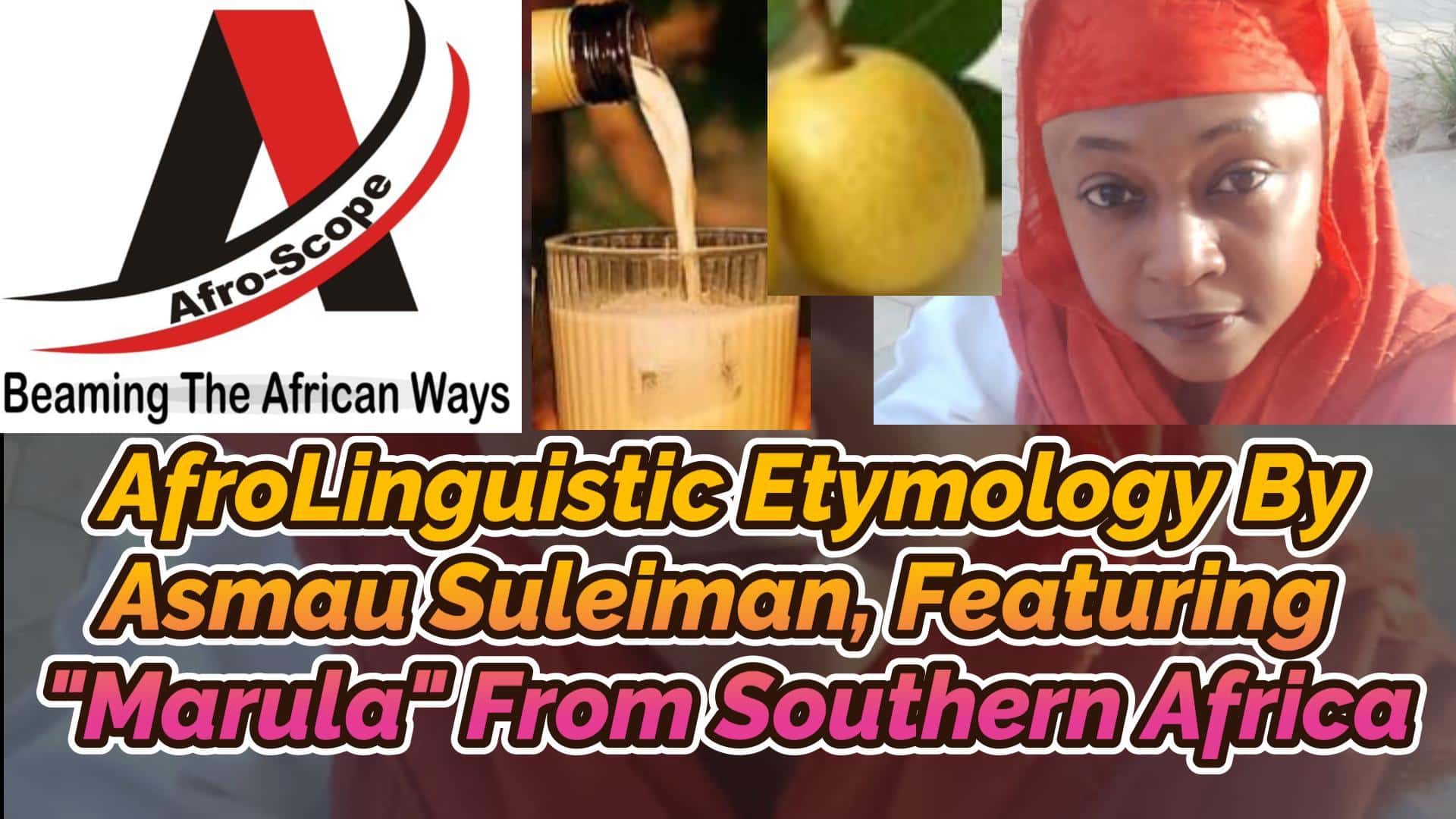
It’s time again for another edition of Afro-Scope’s AfroLinguistic Etymology series. I am yours truly, Harry Agina, bringing it to you with our gorgeous philosophically poetic or poetically philosophical etymologist, Asmau Suleiman. I give you the foundational prelude, and Asmau takes you on the rest of the journey. As you have seen in our title, the focus this time is MARULA, a word from southern Africa.
Now, let’s dive in with my prelude. This time, I add a new dimension to the series. I am complementing the “AfroLingustic Etymology” with a little of our “AfroCentric (Africa-Centered) Titbits” series. In other words, I am going beyond the origin and journey of the word, MARULA, to African contributions to the world with the very valuable tree that bears the name. It is native to the woodlands of southern and western Africa, where indigenous communities and ancient hunters have utilized its fruits, nuts, and oil for over 10,000 years.

MARULA, the word, became popular in the world and began its journey into mainstream dictionaries in the 1850s because of the values of the tree that bears the name. The story is similar to that of the RED BERRY tree that was discovered in Ethiopia (East Africa) in the 9th century AD, out of which COFFEE is brewed. The many values of the MARULA tree were discovered by Southern Africans over 10,000 years ago. The rest of the world got the information of the great values only a few centuries ago in the 19th century AD. It was then that marula made its way into global mainstream dictionaries.
Remember that the reason for the entire story is that Afro-Scope is mandated to present the many contributions of Africa to the world. You most likely know that Africa is the cradle of humanity, where everything about the human species started and evolved. The evolutionary video story is right here for you on this site. To save you the stress of searching, I have the link at the end of this story. I also have the link to another thrilling video story that is similar to the present marula story. I speak of when, how, and why the coffee beverage so much loved today by the “White man” was discovered by a sheep herder in Ethiopia, East Africa.

Now, back to the rest of the marula journey into mainstream dictionaries. And here is Asmau Suleiman with the rest of the story for you. It’s one of those words with slight transformation in spelling and pronunciation as they journeyed into mainstream dictionaries. Here we go:
Hi. I’m Asma’u Suleiman, and this is the Afro-Scope Project, where African words travel beyond borders, carrying pieces of Africa with them.
Some African words travel with music…
Some travel with people…
And some travel because nature itself introduces them to the world. MARULA is one of those words that nature introduced to the world through Africa.
Today, the word marula is recognized far beyond Africa. It appears in discussions about nutrition, skincare, traditional medicine, conservation, cosmetics, and even one of the world’s best-known cream liqueurs, AMARULA, named after the fruit itself.

But long before it became familiar on supermarket shelves and cosmetic bottles around the world, marula belonged to the landscapes and languages of Southern Africa. The English word MARULA came from the Tswana language word, MORULA, or from a closely related Southern African language. As the tree, its fruit, and its many uses became known beyond the African continent, the indigenous African name travelled with them into English. It travelled with slight evolutionary transformation in spelling and pronunciation from MORULA to MARULA.
That journey reminds us that words, like seeds, often travel with the things they name. The marula tree (Sclerocarya birrea) is one of Africa’s most treasured native trees. Its golden fruit is juicy, fragrant, and naturally rich in vitamin C. The fruit is enjoyed fresh and is also used to make juices, jams, and other traditional foods and beverages, including the world popular cream liqueur called AMARULA.

Its kernels are edible and nutritious. Its leaves provide shade. Its bark has long featured in traditional medicine. The tree is equally loved by Africa’s wildlife. Elephants, antelopes, baboons, birds, and many other animals feed on its fruit, making the marula an important part of the ecosystems where it grows.
For many communities across Southern Africa, the marula tree is more than a source of food. In some regions, the annual marula harvest is celebrated with community festivals, marking the arrival of the fruiting season and honoring a tree that has sustained generations.
In recent decades, marula has found an even wider audience. Its oil has become highly valued around the world for skincare because of its moisturizing qualities, while the fruit itself became internationally recognized through products such as Amarula cream liqueur.
Yet behind every modern product is an older story. A story of African communities who had known, used, and valued the marula tree thousands of years before the rest of the world discovered it.
Perhaps that is the quiet beauty of this word. It reminds us that sometimes a language travels because a remarkable tree travels with it. A fruit becomes known…
A tree becomes admired…
And the name given to it by African people crosses borders too.
MARULA…
A Southern African word….
A remarkable African tree….
A name that has grown far beyond the land where it first took root.
Until next time, keep speaking Africa…..
Even when you don’t know you are—
ASMAU SULEIMAN
LINK TO THE THRILLING STORY OF THE DISCOVERY OF COFFEE IN EAST AFRICA: https://afro-scope.com/2025/12/14/afrocentric-titbits-featuring-the-cradle-of-coffee-in-the-world/
LINK TO THE THRILLING STORY OF AFRICA AS THE CRADLE (ORIGIN AND EVOLUTION) OF HUMANITY: https://afro-scope.com/2025/11/08/afrocentric-titbits-featuring-africa-as-origin-of-humanity-and-human-evolution/