

November 21, 2026
Written By Asma’u Suleiman.
Supervisory Editing And Augmentation By Harry Agina.
Greetings!
I am Harry Agina with the Afro-Scope Project, bringing you another edition of AfroLinguistic Etymology series. Like I do from time to time, I will inform those who may not know the purpose and background of this series.
It is a fact that English is the most dominant language in the world. It is also a fact that a lot of the words of English language were borrowed and adapted, and are still being borrowed and adapted from words of various languages of the world—Latin, French, Greek, you name it. And yes, most important to the Afro-Scope Project, countless number of words of various African languages have made their way into the English vocabulary. No doubt, many more African words will continue to enter mainstream English dictionaries, recognized and appreciated by the world.
Some of the African words in the mainstream English dictionaries made the journeys exactly in their original forms of spelling and pronunciation. Others went through evolutionary processes that involved influences of non-African cultures and languages. Their spellings and pronunciations were slightly or heavily transformed as they made their way into the English dictionaries. Either way, the African meanings and essences of the words always remain intact. Mind you, the evolutionary transformation or adaptation processes are not peculiar to African words. Many words of French, Latin, Greek, and other global origins were adapted before entering English dictionaries.
The study of the origin, history, and evolution of words across languages is called Etymology.And, Afro-Scope’s Afrolinguistic Etymology series traces the origins, history, and evolution of African words as they enter mainstream English dictionaries.It is important at this point to state that the word Afrolinguistic and the term AfroLinguistic Etymology are my own coinages (creations) for the Afro-Scope Project. So, do not bother to look it up now. However, you can bet that they WILL get in the mainstream dictionaries sooner than later because the Afro-Scope Project has created and popularized it.
So far, counting this one, we have 31 AfroLinguistic etymologies right here on Afro-Scope.com, and the journey continues as our perpetual mandate.
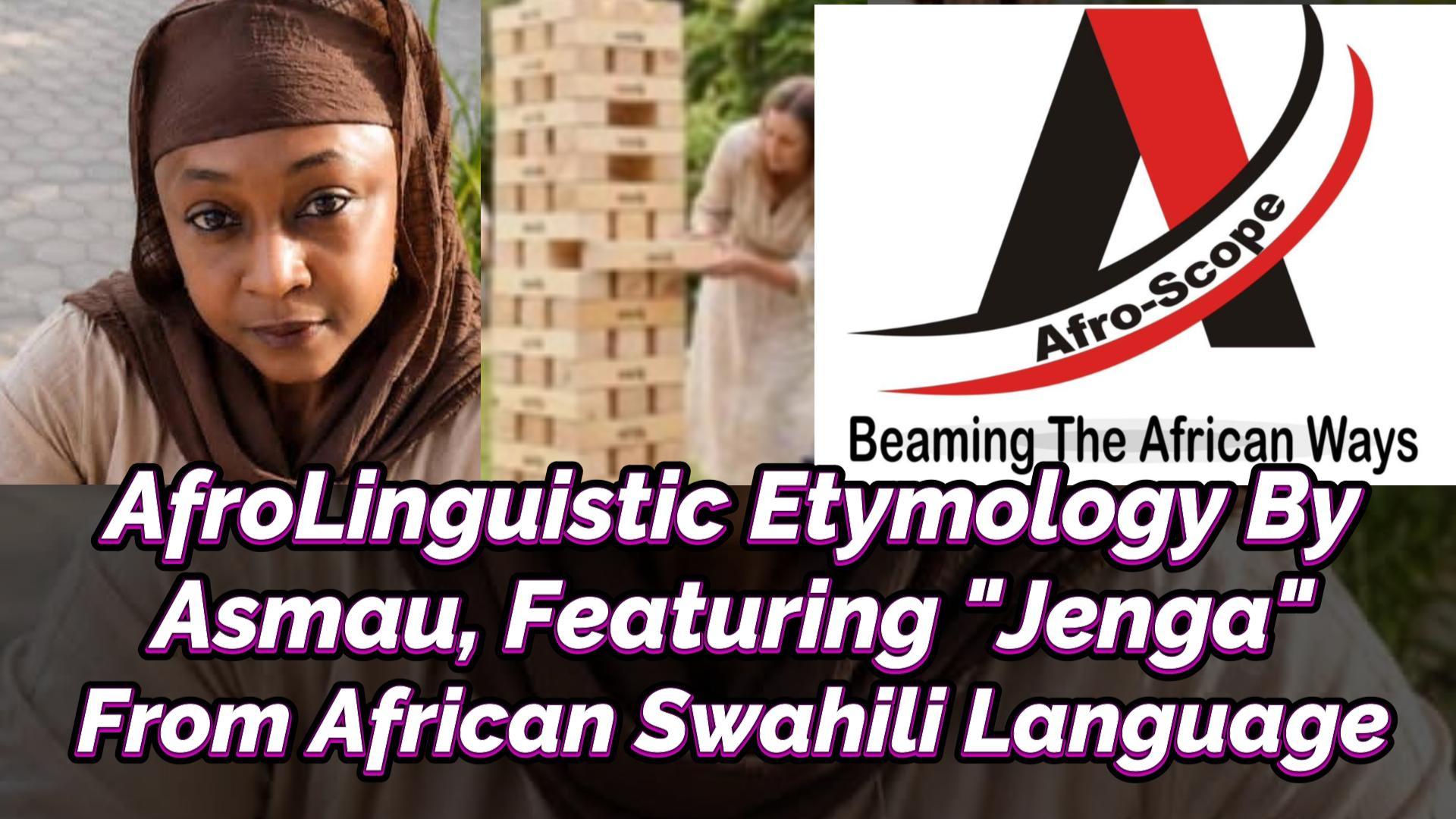
Now, let’s get on with the job of the day. It is my pleasure to introduce my colleague, the gorgeous Asma’u Suleiman to continue the edition with the word, JENGA — “The African word that built a game,” as she puts it. Here we go:
Sometimes, a word travels because people carry it across borders…
Sometimes, it travels through music, food or fashion…
And sometimes, as the word we have today, it travels one wooden block at a time.
Today, we are exploring a word that has become familiar in homes, schools, parties and game nights across the world. The word is Jenga.
Hello, I’m Asma’u Suleiman, and this is the Afro-Scope Project, where we follow the journeys of African words and discover the histories they carry.
A WORD THAT MEANS TO BUILD:
Jenga is rooted in Swahili, the widely spoken East African language. It comes from the Swahili verb—JENGA, meaning to build or construct. The infinitive form is KUJENGA.
It is a wonderfully appropriate name for a game whose entire purpose is to build a tower. But how did an African word become the name of an internationally recognized game? For that, we must meet the woman who gave the game its name.
FROM A FAMILY GAME TO AN INTERNATIONAL PHENOMENON:
The game was developed by Leslie Scott, a British game designer who was born in what is now Tanzania, and grew up in East Africa speaking both English and Swahili.
The story began within her family in the early 1970s. Her family had acquired wooden building blocks made by a craftsman in Ghana. The blocks became the foundation of a stacking game that the family enjoyed playing together. They initially called it Takoradi Bricks, after the Ghanaian city associated with the blocks.
Over time, the family game evolved. Scott recognized its potential and developed it into a commercial game. When she brought it to the British market in the early 1980s, she chose the name Jenga, drawing from the Swahili word for building. The game was introduced at Harrods in London in 1982 and later launched internationally.
A word from an African language had acquired a new identity. And the world was about to learn it.
THE TOWER THAT TESTS YOUR NERVES:
For anyone who has never played Jenga, the idea is beautifully simple. The classic game comes with 54 wooden blocks arranged into a tower. Each level contains three blocks, with the direction of each level turned at a right angle to the one beneath it.

Players take turns carefully removing one block at a time and placing it on top of the tower. The challenge is to keep the structure standing. As the game progresses, the tower grows taller, the gaps become more noticeable, and every move becomes a little more dangerous.
One careless movement, one poorly chosen block, and the entire structure comes tumbling down. The player whose move causes the tower to collapse loses.
Simple? Certainly…
Relaxing? Not always! Jenga is a game of patience, balance, concentration and steady hands. It can turn a peaceful family gathering into a room full of suspense, laughter and dramatic reactions. And perhaps that is why it has remained so popular.

WHEN AN AFRICAN WORD BECOMES A GLOBAL NAME:
Jenga was launched in North America in 1986 and grew into an international game, distributed through major toy companies and licensed manufacturers. It has since inspired numerous variations, including giant outdoor versions, themed editions and electronic adaptations.
The game is now recognized in countries far beyond the language community from which its name came. Yet the word has retained its original inspiration…
Jenga…
Build…
A name that describes the very action at the heart of the game. There is something especially interesting about this journey.
The wooden blocks that helped inspire the game came from Ghana. The woman who developed and named it grew up speaking Swahili in East Africa. The game was commercialized in Britain before finding audiences across the world. Its history is not simply the story of an African invention exported unchanged. It is a story of cultural experience, family creativity, international enterprise, and an African word finding a remarkable new destination.
THE WORD THAT KEEPS BUILDING:
Today, people may recognize Jenga first as the name of a game rather than as a word with a Swahili connection. But beneath that familiar name is a simple African expression…
A word for building…
And perhaps, that is the perfect ending for our journey.
A family played with wooden blocks…
A game was developed…
A name was chosen from an African language…
And eventually, millions of people around the world began saying that name — Jenga! An African word that became a global game.
And that is the beauty of etymology: Sometimes, a word doesn’t merely travel. It builds something along the way.
Keep speaking Africa, even when you don’t know you are…
Until next time.
Meanwhile. here is a link to a Jenga Tournament for you: https://youtu.be/ji6FlRxvpig