

May 17, 2026
Greetings from Harry Agina with the Afro-Scope Project!
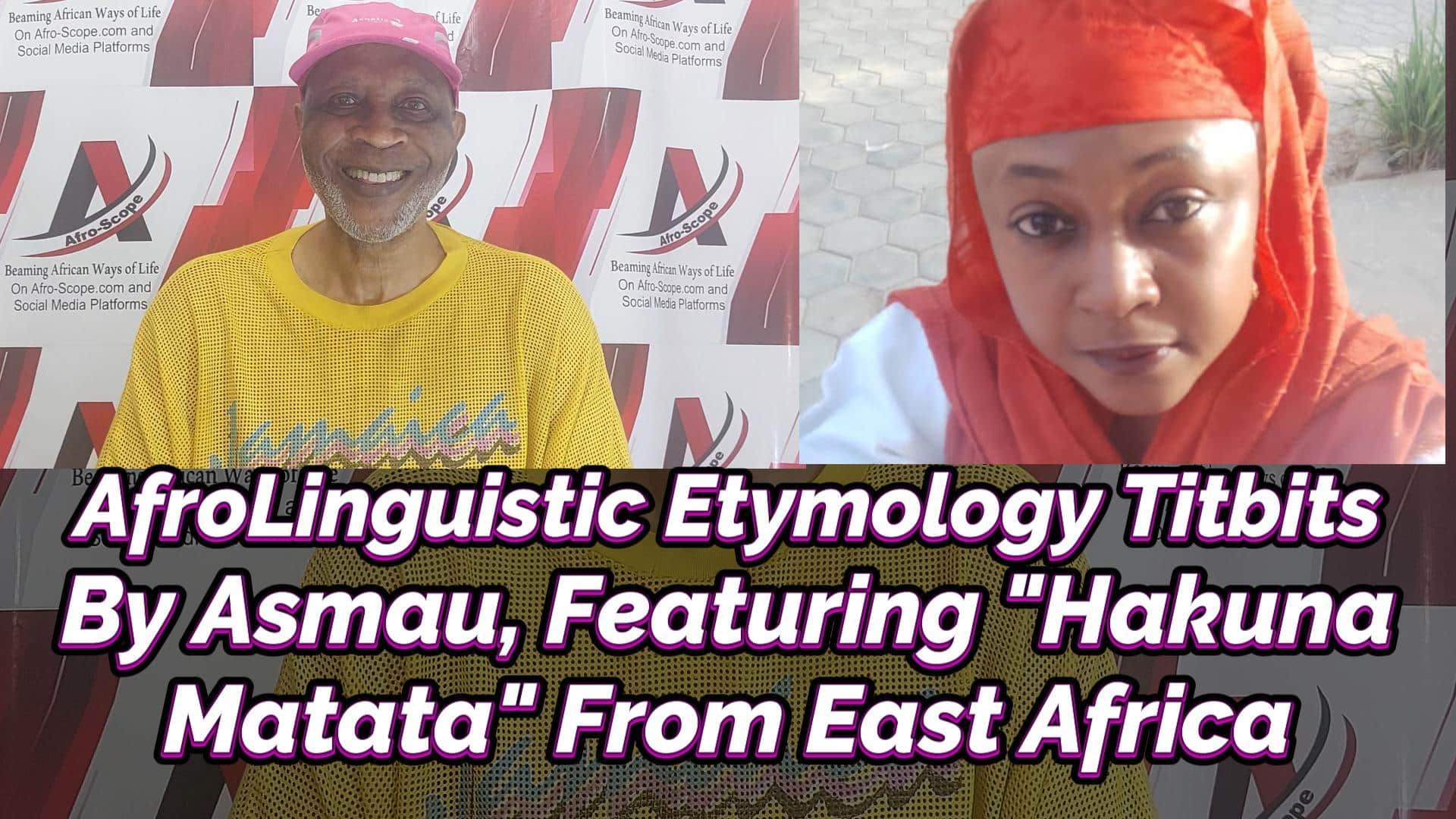
I implore you to watch this introductory video, and then check below for what it introduces…one among the great poetic and philosophical series by our lady of the pen, Asmau Suleiman:
Hello!
I am Asmau Suleiman with the Afro-Scope Project. In my very first edition of this series, I shared with you the word “WAHALA” from Nigeria in West Africa, which means problem, or trouble or worries.
This time, I am here to share with you another beautiful piece of African ETYMOLOGY, this time featuring a phrase, HAKUNA MATATA from East Africa, which is similar to the Nigerian “Wahala.” However, whereas the single Nigerian word “Wahala” translates to trouble or problem or worries, the East African phrase, “Hakuna Matata” is AFRICA’S GIFT OF “NO WORRIES” or “NO TROUBLE.”
Before Hollywood sang it, East Africa lived it. Long before Disney’s “The Lion King” movie turned the phrase into a worldwide sensation, “Hakuna Matata” was already flowing naturally across the Swahili-speaking coast of East Africa — a simple but powerful expression meaning: “No worries.”
The phrase comes from the Swahili language, widely spoken in countries such as Kenya, Tanzania, Uganda, and parts of East and Central Africa.
“Hakuna” means “there is no,” while “Matata” means “problems” or “troubles.”
Together:
“No problem.”
“No worries.”
“No trouble.”
Simple words.
Deep philosophy.
In many African communities, life has never been easy. Yet somehow, laughter survives. Music survives. Hope survives. Human warmth survives.
That is the spirit hidden inside Hakuna Matata.
It is not the denial of hardship.
It is the strength to endure hardship without allowing it to destroy the spirit.
It is the ability to replace worry with laughter, replace fear with music, and continue moving forward despite life’s burdens. Not because the problems do not exist, but because the human spirit chooses not to surrender to them.
In that choice, strength begins to rise.
The strength hidden inside the human heart prevails quietly, helping people overcome pain, uncertainty, and difficulty, one day at a time.
The phrase became globally famous after Disney’s “The Lion King” movie introduced it to millions of people in 1994 through one of the most memorable songs in animation history. Suddenly, children and adults across the world were singing a Swahili phrase without even realizing they were carrying a small piece of Africa on their tongues.
But beyond the song lies something more meaningful.
Hakuna Matata reflects a universal human desire: peace of mind.
In a stressful world full of bills, responsibilities, deadlines, heartbreak, anxiety, uncertainty, and endless pressure, Africa quietly offered the world a phrase that says:
“Breathe.
Life continues.
Do not let worries destroy you.”
Even with tons and tons of responsibilities resting heavily on our shoulders, embracing Hakuna Matata is not about becoming careless. It is about adjusting the mind and refusing to live every day consumed by fear and worry.
It is the quiet decision to tell yourself:
“There will always be challenges, but I will still live.
I will still smile.
I will still breathe.”
Perhaps that is why the famous line from the song touched so many hearts around the world:
“It means no worries, for the rest of your days.”
Because deep down, human beings everywhere long for a life where peace exists beyond pressure — where the soul is not constantly trapped in anxiety.
And maybe that is why “Hakuna Matata” continues to stand the test of time.
Not merely as a phrase.
Not merely as a song.
But as a reminder that life becomes lighter when worry does not control the spirit.
”Hakuna Matata.”
Two words.
One continent.
A global feeling—
ASMAU SULEIMAN