

May 15, 2026
Hello!
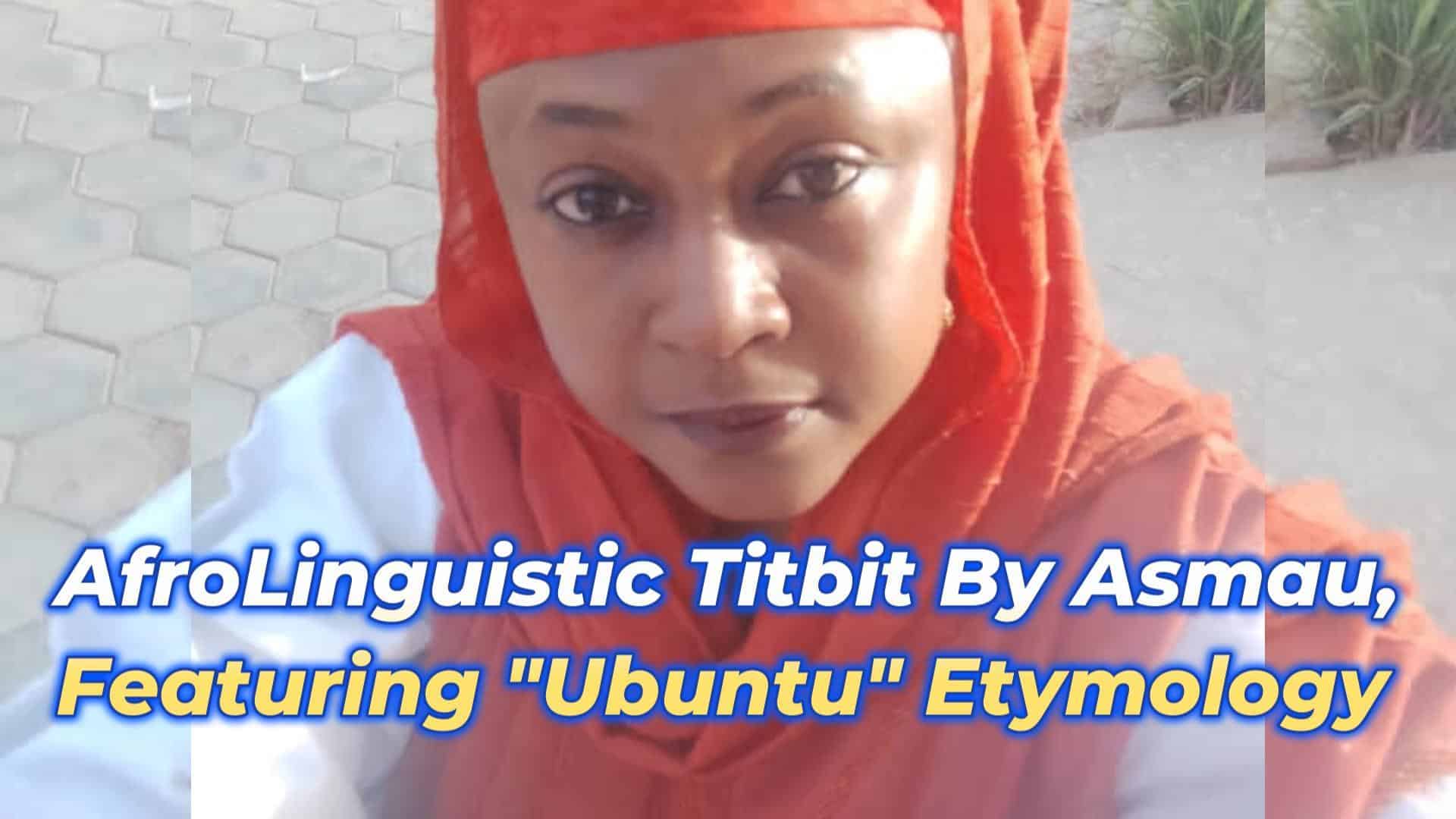
I am Asmau Suleiman with the Afro-Scope Project. I am here to share with you another powerful piece of African ETYMOLOGY, featuring the word “UBUNTU.” It is a beautiful African philosophy.
It’s a simple expression carrying profound ideas about humanity, kindness, community, and our shared existence as human beings.
The word Ubuntu comes from Southern Africa, especially among the Nguni Bantu languages like Zulu and Xhosa in South Africa. And the simplest explanation of Ubuntu is:
“I AM BECAUSE WE ARE.”
That’s it!
But also… that is not it at all. Because that six-letter African word (Ubuntu), which translates to that five-word English phrase (I am because we are) contains enough philosophy to humble modern civilization.
Ubuntu is the idea that a human being is not truly human alone.
That kindness is not weakness.
That community is wealth.
That your humanity is tied to mine.

In African culture. Ubuntu goes even further:
If a child is hungry in a village, Ubuntu says:
“That is our child.
Let’s feed our child ”
If an old woman falls carrying firewood:
“You do not pass her by.” You help her.
If someone succeeds:
“We rise together.”
Ubuntu is why, in many African homes, visitors are fed before questions are asked.
Ubuntu is why a struggling cousin can suddenly appear in your house and stay for six months and somehow everybody adjusts.
Ubuntu is why some Africans abroad cry after many years because they suddenly realize:
“People back home may be poor… but they never allowed me to feel alone.”
And perhaps the most painful thing about Ubuntu…
…is how modern life slowly kills it with:
* Locked gates.
* Headphones.
* “No one should disturb me.”~DND~
* “Mind your business.”
* Hyper-independence.
* A person can live in a building for ten years and not know the name of the person next door.
And that would have confused many traditional Africans deeply.
Because to them, survival itself was communal.
Ubuntu became globally famous partly because of Desmond Tutu and Nelson Mandela, who often spoke about it after Apartheid.
* Not revenge.
* Not domination.
* But restoration of humanity.
And perhaps that is why the word touches people universally.
Because somewhere deep inside, nearly every human being wants to belong to something warm:
To be seen.
To matter.
To not walk through life spiritually abandoned.
Ubuntu says:
“Your existence is connected to others.”
And that is both comforting… and terrifying.
Because it means we are responsible for one another.
Chills run through my spine though, as it is not what we practice–
BY ASMAU SULEIMAN
“UNBUNTU” IN AFRICAN CULTURE COMPARED TO WESTERN CULTURE BY HARRY AGINA:
I will draw this comparison with a simple personal experience in Houston Texas in the USA. Once upon a time in the 1980s, I was living with my fiancée, an American lady. We had plans to get married. One day, out of the blues, my cousin surprised me with a phone call from Houston Airport. He had just arrived from Nigeria with an admission into a college in Houston as a day-student. I was his only close relative in Houston, and it was NATURAL that I helped him to lodge with me until he got his act together to get his own apartment.
Fast forward to six months later. My cousin was still lodging with my fiancée and me. She had started grumbling over four months earlier that my cousin had long overstayed his welcome as a lodger in our home. Even more impossible for my fiancée to condone was the fact that my cousin did not even bother to pre-inform us before he “invading” us as a lodger in our home.
Fast forward again to the fact that my fiancée and I ended up breaking up. The marriage didn’t happen because I pleaded with her to allow my cousin a little more time to get his own apartment. When I mentioned my AfroCultural COMMUNITY OBLIGATION (Ubuntu) to harbor my cousin until he could stand on his own, my fiancée’s response was: “To hell with your African cultural obligation.”
So, yes, before westernization crept and ate into the African Culture in the disuniting name of modernization, UBUNTU reigned supreme in Africa–
HARRY AGINA.