

August 26, 2026
Greetings!
This is Harry Agina, introducing another edition of Afro-Scope’s AfroLinguistic Etymology with my colleague, Asmau Suleiman. As always, I give you my background prologue, and hand hand you over to Asmau to take you through the rest of the journey. In previous etymologies, we took you through some words of culinary and beverage values out of Africa. The recent ones included “Couscous” and “Marula.” If you missed those posts, not to worry. Simply search for the words, Couscous and Marula right here on this site, and you would easily find them.
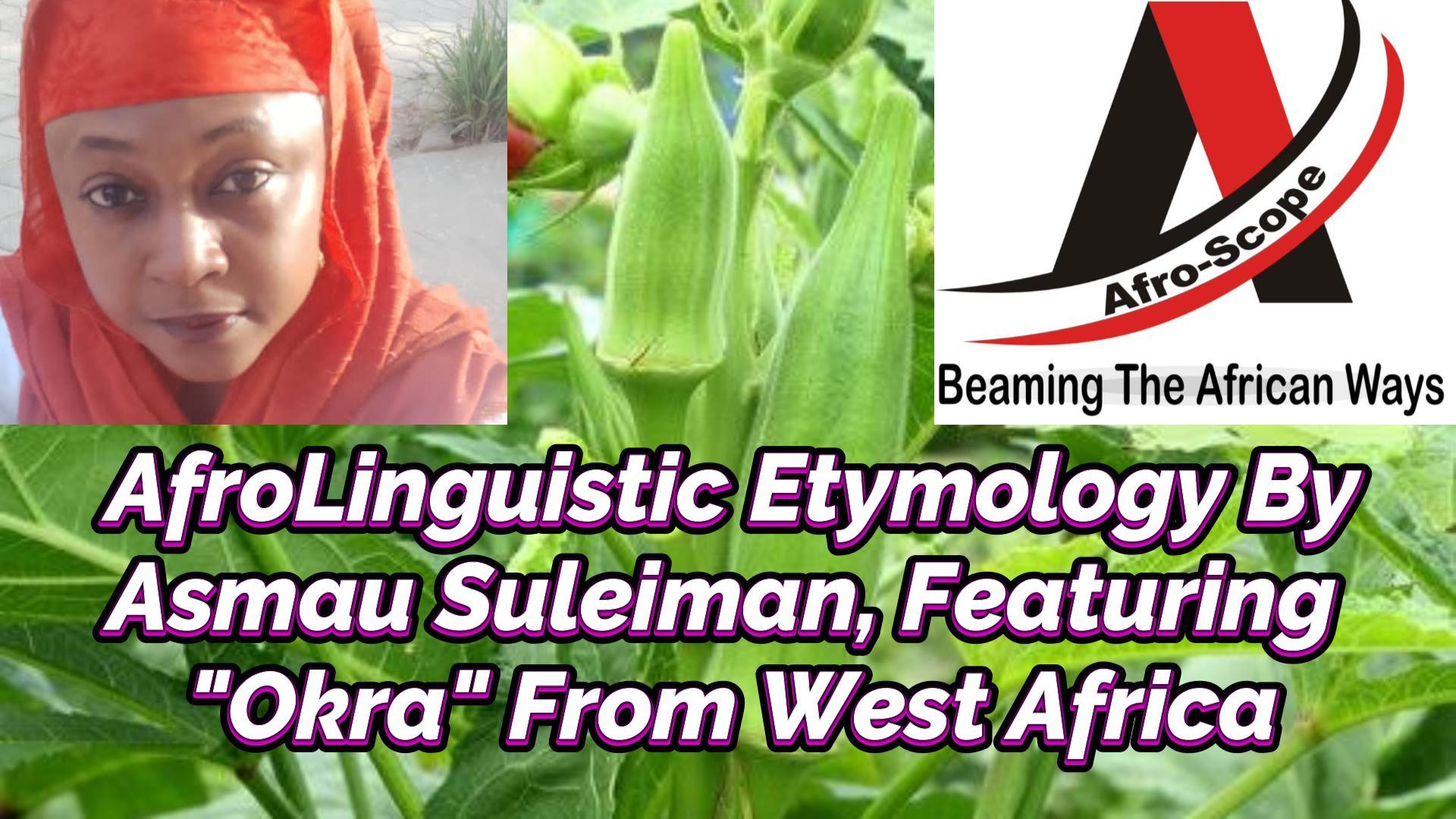
This time, we come with another ‘edible’ word, Okra. Here is Asmau Suleiman to take us through the journey:
Hi. I’m Asma’u Suleiman, and this is the Afro-Scope Project—where African words travel beyond borders, carrying pieces of Africa with them.
Some words crossed oceans because explorers carried them. Some travelled because merchants traded them. And some survived one of history’s darkest journeys. OKRA is one of those that survived history’s darkest journeys.
Today, okra is a familiar word in English and a beloved ingredient in kitchens around the world. It appears in soups, stews, and traditional dishes from Africa to the Caribbean, the Americas, the Middle East, and beyond. Yet, few people realize that the word itself is African.
The English word OKRA was from the Igbo word ọ́kwụ̀rụ̀ (also rendered ọkùrù), spoken by the people of the Igbo tribe in southeastern Nigeria. The plant with the name arrived in the colony of Virginia in the USA with Africans enslaved through the transatlantic slave trade around the year 1619. Before the arrival of the African slaves, the plant did not exist in the Americas. Obviously, the name did not exist either. The African slaves brought with them the plant and the knowledge of how to cultivate it. They also arrived with the name ọ́kwụ̀rụ̀ by which they had always known it.
With evolutionary transformation in spelling and pronunciation from the original ọ́kwụ̀rụ̀ to okra, it entered the English language dictionaries in 1679. This is one of the clearest examples of an African word taking root in the English language. Like the seed and the plant, the word crossed the Atlantic.
It survived displacement…
It survived slavery…
And it continues to be spoken today.
Okra itself (Abelmoschus esculentus) has nourished African communities for generations. Its tender green pods are prized for their distinctive texture, finding their way into delicious draw soups and stews enjoyed with favorites such as pounded yam, eba, semovita, tuwo shinkafa, and many other African swallow foods. Beyond Africa, it has also become a cherished ingredient in Caribbean, Brazilian, Middle Eastern, Creole, and Southern American cuisines.
Yet, wherever the dish is served, the word quietly remembers its journey. Imagine the moment centuries ago…
Someone planted the seed…
Someone recognized the familiar green pods…
Then someone spoke the name they had always known…
Ọ́kwụ̀rụ̀…
In that simple word was memory…
In that memory was home…
The plant had crossed the Atlantic…
So had the language.
Every time the word okra is spoken today, it carries the faint echo of that first recognition—when an African name survived an ocean and found a place in the English language.
A simple vegetable…
An extraordinary journey…
An African word that continues to remind the world that even in humanity’s darkest chapters, language has a remarkable way of enduring.
Until next time, keep speaking Africa… even when you don’t know you are—
ASMAU SULEIMAN