

November 28, 2026
Written By Asma’u Suleiman.
Supervisory Editing And Augmentation By Harry Agina.
Greetings from Harry Agina and the Afro-Scope team on Afro-Scope.com. We bring you another AfroLinguistic Etymology, edition 32. If you missed the past 31 editions, not to worry. They’re all here on this site in our AfroLinguistic Etymology Category. In fact, I will make it easy for you with the link to edition one at the end of this, and edtion one will link you to the rest.
In the past editions, we talked about some African words that went through some transformations in spelling and pronunciation in their journeys from African languages into mainstream English dictionaries. In some cases, their meanings were slightly ultered by foreign cultural influences. Either way, however, they remained unchanged in essence. We also had some words whose journeys happened without any form of evolutionary transformation or alteration.
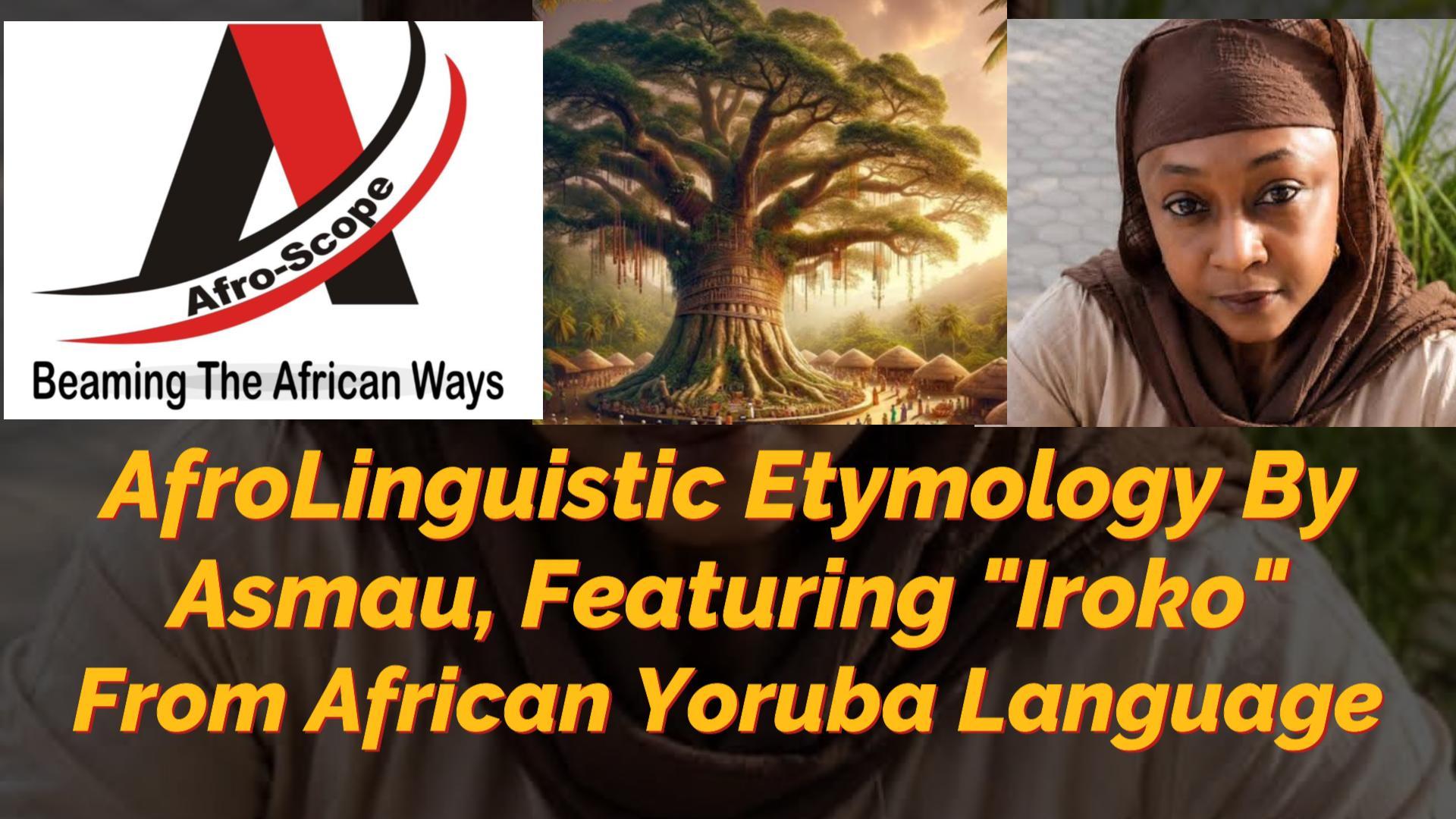
Today, we have another one of the African words that made their way into mainstream English dictionaries without any form of transformational evolution or evolutionary transformation. The spelling and pronunciation remain intact. The word is IROKO — the name that builds strong structures across the world. It travelled from West Africa to mainstream English dictionaries with one of the strongest, tallest, and most useful trees in the world.
Enough of my prologue now, and time to bring in my gorgeous philosophically poetic or poetically philosophical colleague, Asma’u Suleiman. She takes us through the rest of the IROKO etymological journey. Here she goes:
Hi, I’m Asma’u Suleiman from Afro-Scope, with today’s etymology. Some African words travel through music…
Some travel through food…
And some travel through the things people make.
But today’s word has a rather different way of reaching the world…
It grows…
It stands tall…
And eventually, its name travels as far as its timber — IROKO.
If you’ve ever encountered the name, you may know it as a magnificent African hardwood tree, prized for its strength, durability and beautiful timber. But before we follow the tree around the world, let’s begin with the word itself.

IROKO — The word comes from Yoruba tribe language of southwest Nigeria in West Africa, where the tree is known as IRÓKÒ. English dictionaries record it as a borrowing from Yoruba, with its use in English documented by the nineteenth century.
And here, we have something important for Afro-Scope. This is not simply an African tree with a name that happens to sound African. Iroko is an African word that entered the English language.
But what exactly is the tree behind the name? The iroko commonly refers to Milicia excelsa, a large tropical African hardwood tree belonging to the mulberry family. It grows tall, develops an impressive crown and can become a striking presence in the forests where it thrives.
Its timber is valued for its durability and resistance to wear, making it useful for furniture, flooring, construction and other woodwork. Because of its qualities, iroko is sometimes marketed as African teak.
But there is a little botanical clarification here. Despite that commercial name, iroko is not a true teak. The two trees belong to different botanical families.
Iroko has earned its own reputation. It does not need to borrow another tree’s identity. And its name has travelled with it.
The iroko tree is found across tropical Africa, and its timber has entered international markets. As the wood reached people and industries beyond its native regions, the name iroko travelled with it.
A word that began in an African language became established in English as the name of a tree whose timber was valued far beyond the communities where it grew.

The tree remained rooted in Africa, while its name travelled abroad. It is unique to African tropical soil, hardly found anywhere outside Africa. It is only recently being introduced experimentally to a few other regions, particularly India, with minimal success.
But there is more to Iroko than timber. In Nigerian Yoruba cultural traditions, the tree also carries cultural and spiritual associations. Some traditions connect the iroko with spiritual presences, and the tree may be treated with particular respect. These beliefs belong to specific cultural contexts, and they should not be mistaken for botanical facts or assumed to be shared by every African community.
Still, they remind us that a tree can mean more to a people than the material it provides…
It can be part of their stories…
Their traditions…
Their relationship with the natural world…
And that brings us back to the word.
Across Africa, the tree is known by different names in different languages. In Nigerian Yoruba, it is ìrókò. In Akan, it is known as odum, in Edo, it is uloko, while the Igbo tribe calls it Ọjì
These names reflect the linguistic diversity of the regions where the tree grows. Yet iroko is the name that entered English ddictionaries and became widely recognised in international timber terminology.
And so, the journey continues…
From a Yoruba word to the English language…
From African forests to international markets…
From the living tree to the wood used in homes, buildings and furniture around the world.
Iroko — a word rooted in Africa…
A tree that reaches towards the sky…
A timber valued for its quality…
And a name that travelled beyond the land where the tree grows.
Perhaps that is what makes this word so fascinating. We often imagine that words travel only when people speak them. But sometimes, words travel because the things they name become known, valued and sought after far beyond their original home.
Iroko reminds us that Africa’s linguistic journeys are not carried by speech alone…
Sometimes, they are carried by the natural world itself…
By a tree whose strength made its timber valuable…
By a name that crossed linguistic borders…
And by the enduring presence of something that began on African soil.
Iroko — the tall tree whose height and quality carried its name into the world. And that is the beauty of etymology. Sometimes, a word travels as far as the thing that bears it.
Keep speaking Africa, even when you don’t know you are.
Until next time.
LINK TO EDITION AFROLINGUISTIC ETYMOLOGY, EDITION ONE: https://afro-scope.com/2026/07/04/afrolinquistic-etymology-by-asmau-suleiman-featuring-mamba-from-the-bantu-language-of-southern-and-eastern-africa/


