

September 10, 2026
Greetings!
I am Harry Agina, introducing another edition of Afro-Scope’s AfroLinguistic Etymology series. Our last edition was about a word of culinary value to the world— OKRA. And of course, you can easily find that edition right here on this site if you missed it.
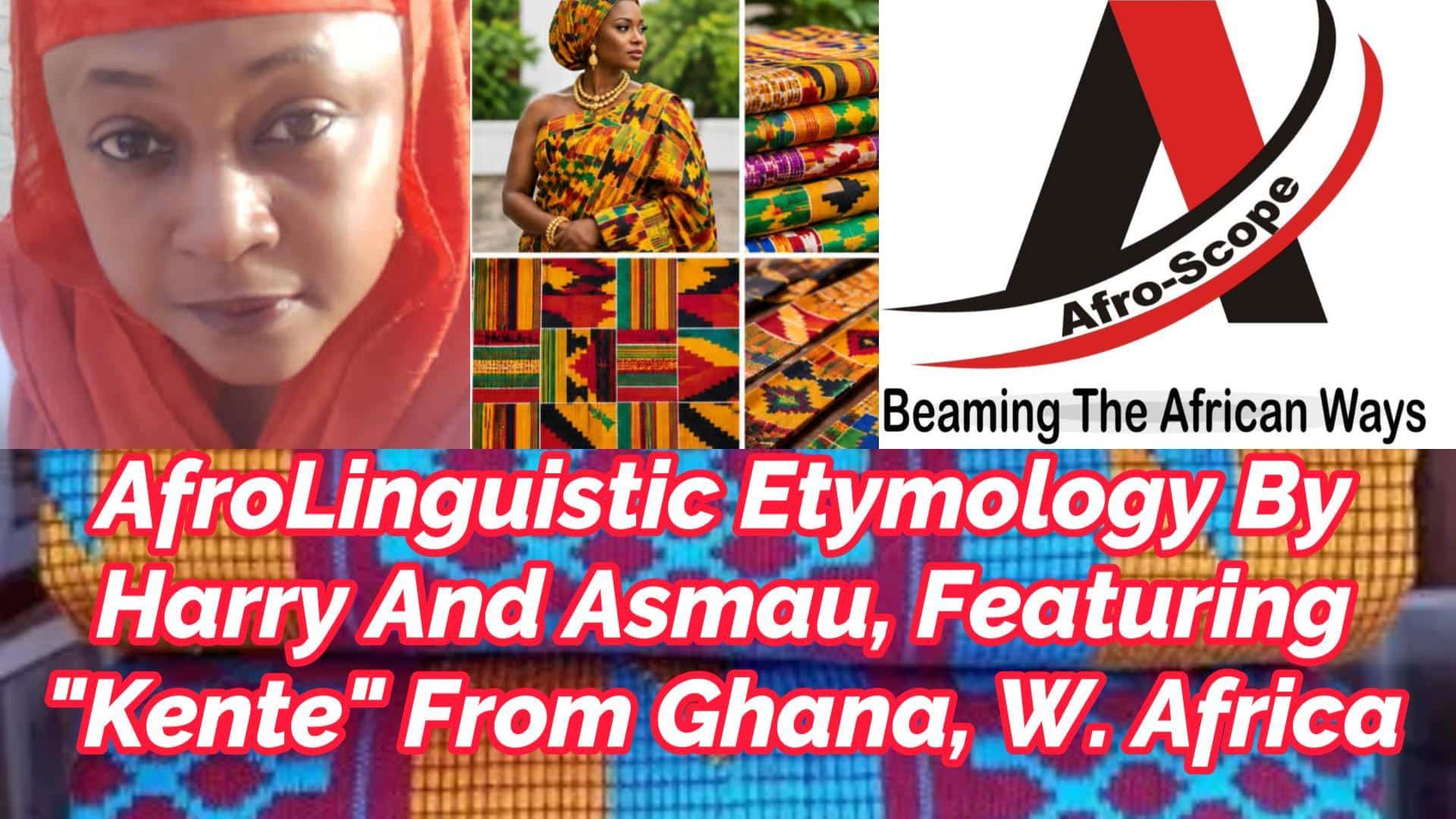
Today’s edition is about a word with textile values to the world. However, we’re going to use one stone to kill two birds for you. The first bird is the AfroLinguistic Etymology of the word. The second bird is African Fashion that is made out of the product that bears the word as a name. I speak of KENTE, a word which names the most uniquely colorful and richly patterned woven textile products that the world has ever seen. Importantly, Kente the textile fabric is more than a fabric. It is a national symbol of the country of Ghana in West Africa.

Now, it’s time to bring in my colleague, the gorgeous poetically philosophical or philosophically poetic etymologist, Asmau Suleiman. She will take us through the rest of this journey of etymology of the word into mainstream dictionaries of the world. It was piloted by the fabric that bears the name. Here’s Asmau for you:
Hi. I’m Asma’u Suleiman with today’s Afro-Scope AfrboLinguistic Etymology. Some words travel through language…
Some travel through people…
And some are carried by things people make with their hands. Today, we are following one of those words for something that people make with their hands…
KENTE— The Word That Was Woven Into World Dictionaries.
KENTE, a name now known around the world for a distinctive, richly patterned colorful woven textile made in Ghana, West Africa. But before we admire the colors, let us investigate the word. Kente has a story. Like many old African words, the story is not quite as simple as it first appears.
The word Kente is recorded in English dictionaries as the name of a colorful handwoven cloth from Ghana. Historical records, however, take us much further back.
Nineteenth-century Akan and Ewe sources contain forms such as kente and kete, showing that the word and the textile belong to a much older West African linguistic and weaving history.
And here, Afro-Scope Investigates. You may have heard that kente comes from the Akan word kɛntɛn, meaning “basket,” supposedly because the interwoven appearance of the cloth resembles a basket.

It is a popular explanation. But it is not an etymology we should present as settled fact. Historical scholarship shows that the terminology appears in both Akan and Ewe-speaking areas of Ghana, while different traditions preserve different accounts of the cloth’s history and name.
So, rather than forcing one answer, we follow the evidence. And the evidence leads us into the remarkable weaving traditions of Ghana and the wider West African region.
Kente is traditionally woven in narrow strips, which are then joined together to create larger pieces of cloth.

(NOTE: THE STORY CONTINUES…)